Get Full Government Meeting Transcripts, Videos, & Alerts Forever!
Get email alerts on the Comprehensive Plan topic
No spam. Unsubscribe anytime.
Commission reviews comprehensive plan draft; staff outlines water, energy, housing priorities and public-notification rules
Summary
Staff previewed the draft Cochise County comprehensive plan (overview, land use, water resource reliance on groundwater, energy goals, housing and economic development) and explained public-notification requirements and next steps for a 60-day agency review and public inspection prior to a future recommendation to the Board of Supervisors.
At a work-session-style portion of the meeting, Cochise County planning staff presented a draft comprehensive plan and walked commissioners through chapters, key goals and next procedural steps for public review.
Overview and purpose: Staff said Chapter 1 frames the county’s identity and key challenges — maintaining rural character while supporting growth, addressing aging infrastructure, protecting water and natural resources, expanding housing, health care and broadband. The draft uses survey data and analysis to identify priorities and has no formal recommendations in the introduction chapter.
Land use and transportation: The land-use chapter includes a future land-use map, categories (A–D) tied to infrastructure and density, and nine goals guiding smart growth. Commissioners urged more emphasis on transportation and county airports to support a new commercial port of entry; staff agreed to add transportation as a major infrastructure project in the plan.
Water resources: Staff emphasized the county’s heavy reliance on groundwater (staff stated 99.7% groundwater) and described conservation, recharge projects and irrigation/community systems. Several commissioners raised concerns about corporate agricultural water use and noted limits on county authority because oversight of water allocation lies with the Arizona Department of Water Resources (ADWR). Staff said the county can still encourage conservation, incentives and coordination with state representatives.
Energy and data centers: The energy chapter encourages renewable energy, resilience and readiness for new technologies (energy storage; small-batch nuclear was mentioned as a potential topic for study). Commissioners discussed the lifecycle and maintenance issues of wind turbines and solar panels, the energy demands of data centers, and whether the plan should favor projects that deliver local economic benefits such as local hiring or processing.
Public services, housing, economic development: Staff recommended a countywide fire/EMS coverage analysis, described housing goals (support for renters, first-time buyers, attention to colonias), and identified economic-development priorities including Fort Huachuca, mining, agriculture, and maximizing the new port-of-entry and broadband expansion.
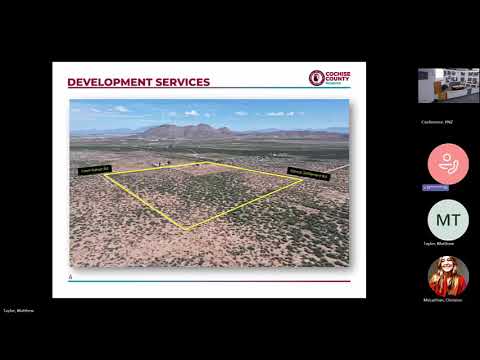
Public-notification rules: Mr. Taylor presented applicable notice requirements: state statute and county rules set minimum notification radii (300 feet for rezones/special uses; 1,500 feet for comprehensive-plan amendments), mailing/posting/publishing timelines (minimum 15 days before a public hearing), and staff discretion to expand notification based on parcel sizes and development patterns. He illustrated how changing radii affects the number of mailed notices in past cases.
Next steps: Staff said the draft will be transmitted for a 60-day agency/jurisdiction review, posted online and in county libraries for public inspection, and returned with compiled comments and staff responses for a public hearing and a commission recommendation to the Board of Supervisors; adopted comprehensive plans are valid for 10 years.
What this means: The presentation was a work-session review (not a public hearing) and no formal adoption or vote on the draft occurred. The transmittal and 60-day review will begin within weeks, after which the commission will consider comments and forward a recommendation to the Board of Supervisors.