Get Full Government Meeting Transcripts, Videos, & Alerts Forever!
Get email alerts on the Embankment Settlement topic
No spam. Unsubscribe anytime.
Jersey City approves embankment settlement and long-term tax pilot despite resident concerns over 30-year abatement
Summary
Jersey City’s City Council approved a settlement to transfer key embankment parcels into public ownership and also authorized a 30-year tax abatement pilot tied to a mixed-use tower, drawing praise from park advocates and sharp criticism from housing and fiscal watchdogs.
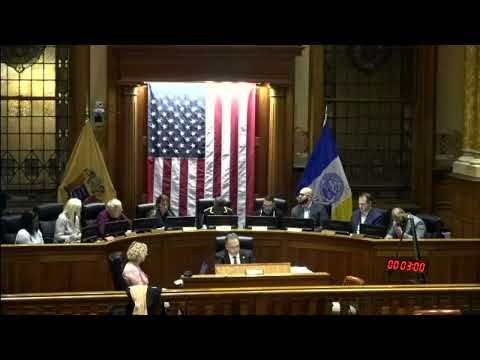
Jersey City — After hours of public testimony and debate, the Jersey City Municipal Council voted to adopt an ordinance settling long-running litigation over the 6th Street embankment and approved a companion long-term tax pilot for development on adjacent Block 11602, Lot 1.
Supporters — including the Embankment Preservation Coalition and a coalition of neighborhood and parks groups — framed the package as a rare chance to secure contiguous urban open space and to protect a 35-year-old urban forest that helps with stormwater, cooling and carbon capture. “With your approval, we can create acres of public open space in the middle of Downtown Jersey City,” Steven Gucciardo of the Embankment Preservation Coalition told the council, describing public staircases, elevators, a pedestrian bridge, and parkland included in the settlement.
Why it mattered: The settlement transfers key embankment parcels to the city and requires the developer to construct public improvements — including a riverfront park, a rebuilt Roberto Clemente field and a pedestrian bridge — timed to building occupancy. Coalition leaders said the package unlocks a long-sought public amenity that could connect the East Coast Greenway through Jersey City.
How the city justified tradeoffs: The council and administration described the tax pilot, structured under NJSA 48:20-1 et seq., as necessary to secure developer commitment for the improvements and affordable housing units included in the deal. Corporation Counsel summarized the financial appendix: the 30-year pilot’s projected gross payments over three decades were presented to the council alongside a conventional tax projection to show the net fiscal tradeoff.
Opposition and fiscal questions: Several residents and housing advocates argued the city gave too much in exchange. “Five percent affordable housing with a generation-long tax abatement is insulting to people struggling to keep a roof over their heads,” said resident Natalie Limon, who urged the council to protect the city’s future legislative and fiscal flexibility. Critics repeatedly asked the administration to publish a clearer side-by-side of foregone revenue versus the estimated $40 million in givebacks and park improvements.
Council action and votes: The settlement ordinance (25-117) passed unanimously. The companion tax abatement ordinance (25-118) also passed, recorded as approved 8–0–1 with Council President Waterman abstaining on the tax pilot vote after an extended public hearing in which opponents emphasized the length of the abatement and the modest affordable-housing percentage tied to the deal.
What happens next: The settlement and pilot are structured to trigger a sequence of development and public improvements; municipal staff and community groups said implementation will require ongoing oversight from planning, legal and parks staff, and that construction of public improvements is tied to developer milestones. Several speakers urged the council to ensure stronger enforcement covenants and to preserve the community’s ability to press for additional affordable housing and hiring commitments.
Public reaction: The public comment record was heavily pro-settlement on environmental and recreational grounds but also included persistent fiscal skepticism and a call for greater transparency about long-term financial impacts. The council’s adoption completes a multi-step package that supporters say will finally transform the embankment into a public greenway after nearly three decades of advocacy.
Next steps: Administration and the developer must finalize required agreements, and council members said they expect follow-up oversight reports as the project moves from settlement to design and construction phases.