
Regents unanimously pass resolution on Fairview–UMP private‑practice agreement, cite lack of transparency and financial risks
Get AI-powered insights, summaries, and transcripts
Subscribe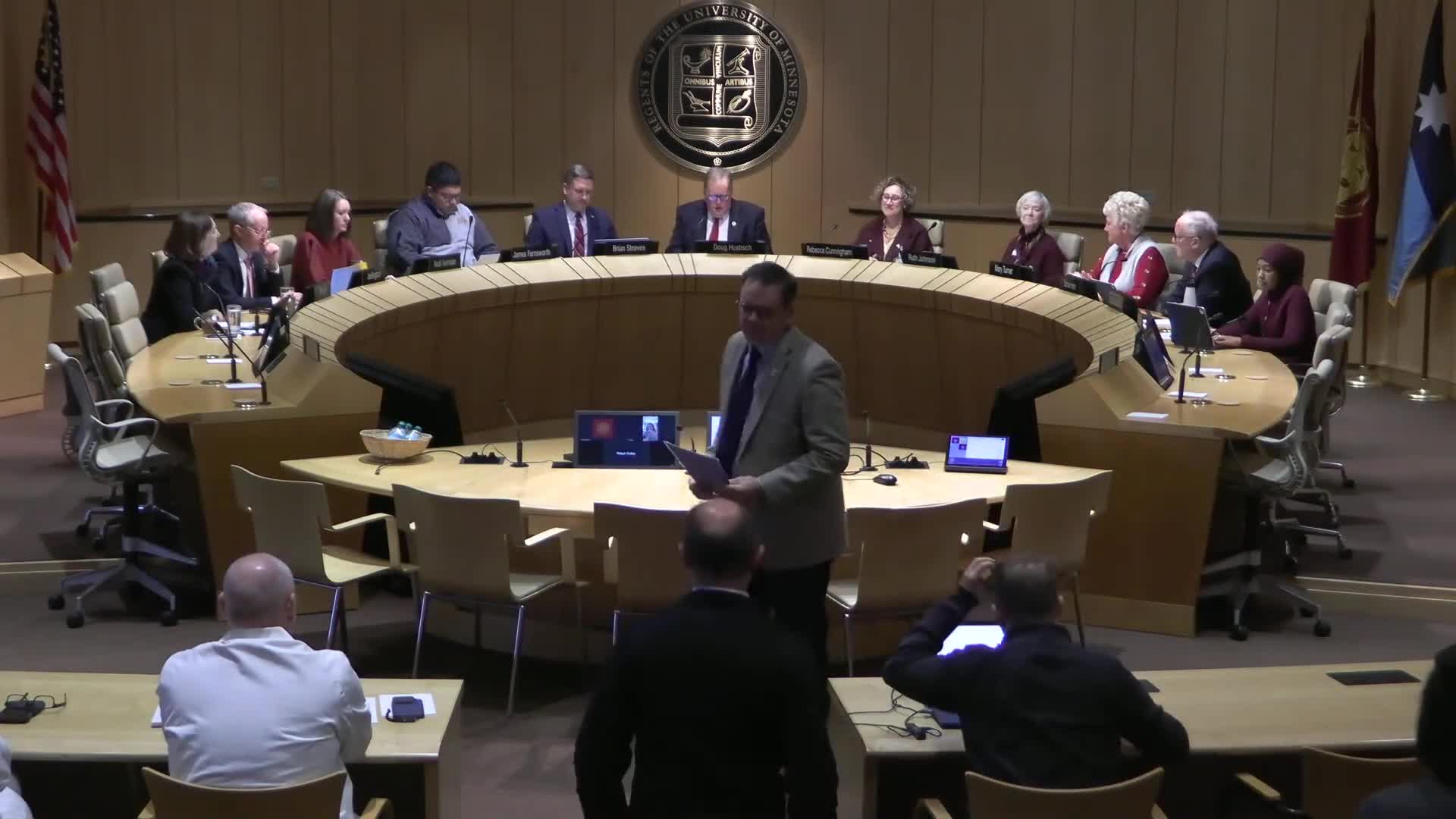
Summary
The Board of Regents unanimously approved a resolution urging protections for the University of Minnesota Medical School after administrators said a proposed agreement between Fairview and University of Minnesota Physicians (UMP) would transfer control, reduce academic support and was negotiated without adequate university consultation.
The University of Minnesota Board of Regents on Nov. 13 unanimously adopted a resolution responding to a proposed private‑practice agreement between Fairview Health and University of Minnesota Physicians (UMP), saying the deal as described poses risks to the medical school’s academic mission, research and statewide clinical training.
President Cunningham told the board the university and faculty were excluded from key parts of the negotiations and that the university did not "walk away" from bargaining; rather, the strategic facilitator declared an impasse and the university was not included in subsequent sessions. Cunningham called the proposed deal "not a path forward" to ensure a thriving medical school and said faculty and staff have expressed serious concerns about transparency and process.
Dr. Keith Ghezzi, an external adviser, summarized details the university has only recently seen and said the proposal appears to transfer primary control of UMP to Fairview by changing board representation, increasing Fairview‑nominated directors, and creating a triad of clinical leaders accountable to the Fairview CEO. Ghezzi warned that similar shifts elsewhere have reduced faculty time for research and education.
Greg Goldman, the university’s executive vice president for finance and operations, told regents Fairview’s widely reported $1,000,000,000 investment over 10 years is misleading because more than half, he said, reflects routine maintenance and replacement of worn equipment. Goldman also cited an estimated historical underinvestment by Fairview of roughly $600–$700 million and said guaranteed academic support in the proposal appears lower than current levels and is tied to Fairview’s financial performance. "At best, it's speculative, and at worst, it destabilizes the medical school," Goldman said.
Provost Ritter and other regents warned the agreement could weaken interprofessional training across the university’s six health‑science schools, undermine rural health commitments and diminish the medical school’s role in research and discovery. Several regents said the university serves patients in all 87 counties and that any clinical agreement must serve the entire state.
Board members debated resolution language that reaffirms the president’s authority—within existing board policy—to take actions including assessing legal remedies, protecting branding and trademarks, and evaluating impacts to academic and mission support. Regents said the university had seen only a short summary, not the full term sheet, and asked administration and counsel to review the document and report back.
A motion to approve the resolution was moved and seconded; the board adopted it by voice vote. Board leadership said the resolution is intended to preserve the university’s constitutional authority over medical‑school policy and to set priorities for administrative follow‑up, while further review of the full agreement and its 30‑page term sheet continues.
Next steps the board identified included legal review, assessment of funding and contract terms, and further engagement with faculty, UMP leadership, Fairview and the state attorney general’s office as appropriate.