Guam lawmakers, regulators and sign industry debate safety, size and spacing in proposed sign-law rewrite
Loading...
Summary
A Guam Legislature roundtable on Nov. 12 reviewed Bill 175-38 COR to update sign laws. Regulators urged safety and enforceability limits; industry groups backed using a previously drafted bill (154-34) as a launch point, calling for clear size, spacing and luminance rules.
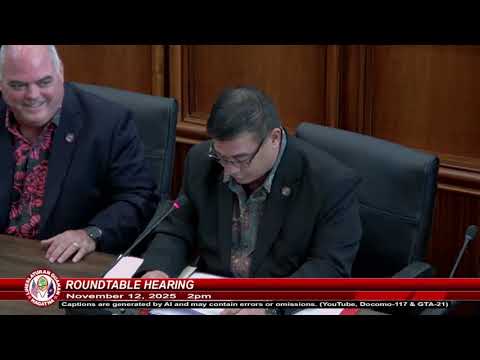
CHAMORRO REGION (Guam Legislature) — Lawmakers, regulators and sign-industry representatives met Nov. 12 for a roundtable on Bill 175-38 COR, a proposal to amend parts of Chapter 61 in Title 21 of the Guam Code Annotated to update the territory's sign laws and standardize the definition of "electronic signs" as "digital signs." The committee heard competing concerns over driver safety, aesthetic impacts and fairness for businesses.
The committee chair said the bill seeks to “make the signs law apply equally to all the businesses” and to avoid leaving businesses to lobby the legislature or sue for variances. “I don't think Guam wants to be a neon city,” the chair said, framing the goal as balancing local character with commercial opportunity.
Department of Public Works officials and safety advocates repeatedly urged technical limits tied to location and driver visibility. The DPW representative warned that moving or flashing displays can draw motorists' attention off the road, saying "when you're driving a 3 or 4,000 pound vehicle ... your attention has to be on the road. It can't be on some sign flashing something here or another sign flashing there." DPW asked the committee to consider luminance controls, distance between signs and mounting standards to ensure signs withstand typhoons.
Industry witnesses from Cherry Media Vision, TriVision Media, Vantage Advertising and Qbink told senators they support regulated access for digital and static signs but want consistent rules. Chris Morado, who worked on an earlier sign bill, urged numeric standards: based on national studies and federal highway guidelines, he said signs should generally be limited to about 200 square feet, spaced roughly 3,500 feet apart for off-premise displays, set back 100 feet from intersections and include automatic dimming tied to ambient light. "Sign should be no bigger than 200 square feet," Morado said, citing prior drafting and study.
Static-sign proponents asked that off-premise static signs be addressed separately from digital displays. Benson Au Young of Qbink recommended keeping the existing static-size baseline (20 by 20 feet, or about 400 square feet under previous practice) and proposed a 500-foot spacing matrix for static off-premise signs. "Off premises sign meaning sign that promote activities or products that don't sell on the property," Benson said as he urged a discrete off-premise section rather than sweeping deletions of current law.
Multiple witnesses and former GLUC officials recounted a history of conflicting attorney-general opinions about the Guam Land Use Commission's authority to grant sign variances. Panelists said earlier AG guidance permitted variances that later AG opinions called "ultra vires," prompting legislative grandfathering for some existing signs. Industry representatives urged clearer statutory authority to remove dependence on shifting AG rulings.
Several senators and the vice chair signaled willingness to use the previously drafted and vetted Bill 154-34 as a "launch pad" for a substitute or amended bill instead of starting from scratch. Vice Chair Senator Duenas and industry witnesses who had helped draft the earlier bill said it contained many of the technical safeguards now being discussed.
But some senators cautioned about procedure and scope. Senator Cholahi said the hearing notice named Bill 175 and asked that, if the committee substitutes a different bill, notice should be explicit because a wholesale substitution could unintentionally repeal laws enacted since the earlier bill was drafted. She also asked DPW for the status of rules and regulations for the Tumon hotel zone, where digital signs are currently authorized, noting the need to reconcile existing laws with any new statute.
The committee closed the roundtable by inviting more written statements for seven days and indicating it would schedule further working sessions and possibly another public hearing before taking formal legislative action. The chair said the aim is to produce a fair, enforceable framework that balances safety, aesthetics and commercial opportunity.
Next steps: the committee will accept written statements for seven days and said it will consider additional roundtables and a subsequent public hearing if it moves to use Bill 154-34 or another substitute as a drafting foundation.