Get Full Government Meeting Transcripts, Videos, & Alerts Forever!
Get email alerts on the Community Concerns topic
No spam. Unsubscribe anytime.
Residents press county on safety, costs and legal limits as flood plans take shape
Summary
At a Coconino County meeting on Muns Park flood risk, residents asked about dam failure risks, private‑property fixes, ADOT engagement and wastewater lagoon inundation; county staff warned that individual actions offer limited benefit, Arizona gift law prevents individual property subsidies, and feasibility and permitting will take time and money.
Residents at a Coconino County Flood Control District meeting raised safety, liability and equity questions after consultants outlined conceptual flood‑mitigation projects for Muns Park.
Multiple residents asked whether private property owners could be empowered or aided to alter on‑lot channels or dredge private areas such as Lake Odell to reduce flood risk. Flood Control District Administrator Lucinda Andreani said individual small‑scale changes would have "almost 0 impact" on the large volumes passing through the watershed and that the district cannot fund work that exclusively benefits one property owner because of Arizona law. "The district can't do things that benefit a single property owner. That's illegal. It's called a gift," she said.
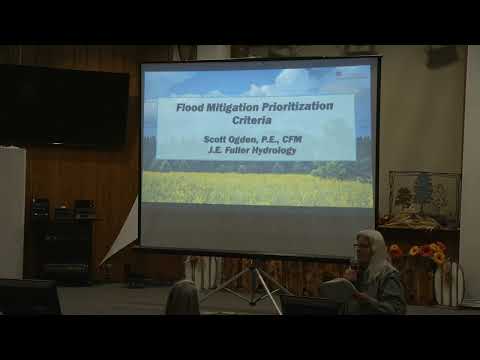
Residents also pressed technical and safety questions about a proposed flood‑retarding structure. One resident asked whether a dam breach could produce a dangerous wave; Scott Ogden, the project's consulting engineer, acknowledged the theoretical risk of dam failure in extreme events and said designs would be to a specific standard and would not aim to mitigate every possible event. He and Andreani said projects would generally be sized to reduce more frequent large events (25–50 year) rather than guarantee protection against a 500‑year event.
Questions about transportation and hazardous materials followed. A former firefighter noted the economic and public‑safety stakes if I‑17 were closed for days or weeks; staff said they are engaging ADOT and are evaluating alternative routes and economic losses for the benefit‑cost analysis. The group also discussed the Pinewood Sanitary District: consultants said the 2004 storm (≈8,100 CFS, roughly a 50‑year event) inundated parts of the system, and lagoon overtopping becomes a risk around a 50‑year level.
Residents asked how they could help secure funding. Andreani said public letters of support to elected officials, formal support from local entities (sanitary district, fire district), and advocacy to ADOT and state leaders would strengthen grant applications. She recommended gathering support once feasibility work provides concrete numbers.
No votes or commitments were taken at the meeting. Staff said they will pursue feasibility funding, complete hydraulics and geotechnical study, coordinate with federal and state agencies, and return with more detailed analyses for board consideration.