Get Full Government Meeting Transcripts, Videos, & Alerts Forever!
Get email alerts on the Traffic Enforcement topic
No spam. Unsubscribe anytime.
APD traffic enforcement briefing: citations up, STEP grant resumes, motors unit rebuilding planned
Summary
Assistant Chief Mike Chancellor told the Mobility Committee Austin has reduced serious‑injury and fatal crashes over 10 years of Vision Zero; APD reported about 11,000 citations through September, targeted campaigns (distracted driving, speeding, DWI) and plans to rebuild motors and DWI units as staffing allows.
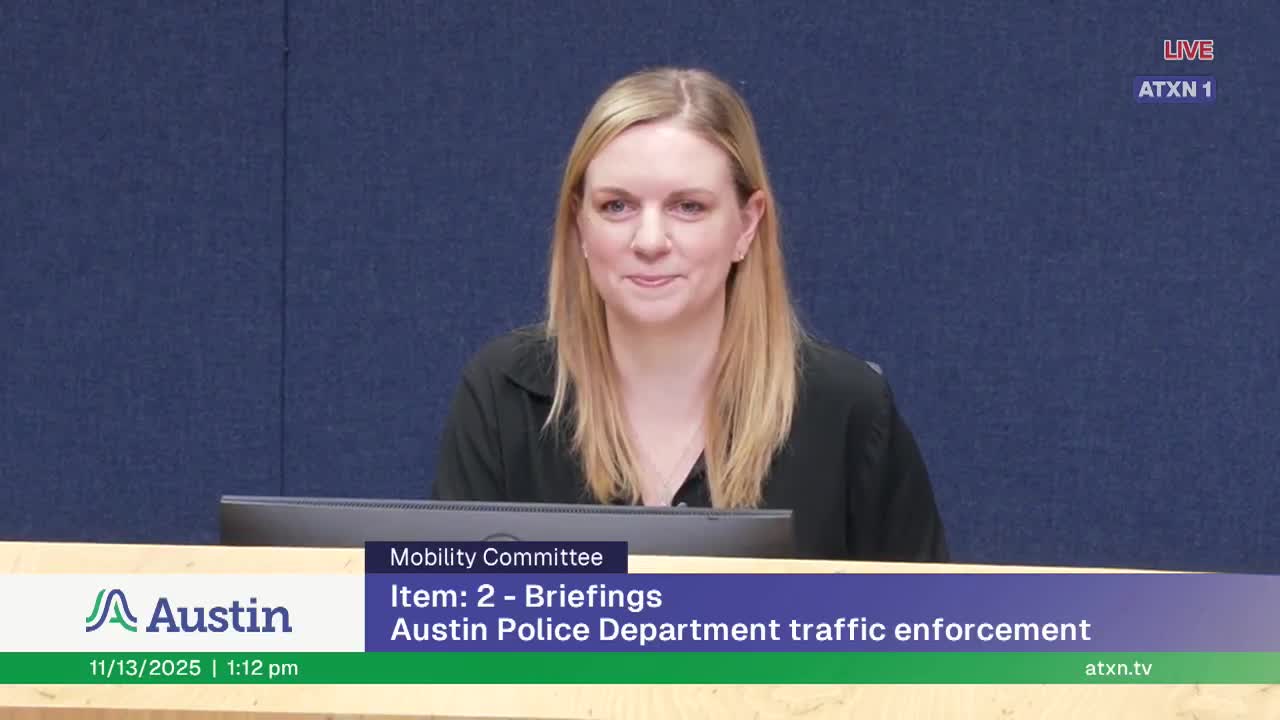
Assistant Chief Mike Chancellor of the Austin Police Department briefed the Mobility Committee on departmental traffic enforcement efforts, tying the work to the city’s Vision Zero goals and describing how data and grant funding shape enforcement activity.
"This is the tenth year with we've been a part of Vision 0," Chancellor told the committee, and he said Austin now ranks lowest per capita for serious‑injury and fatality rates among the state's largest cities according to the latest Vision Zero report. Chancellor said APD has issued "a little over 11,000 citations this year, through September," an increase from last year driven in part by targeted campaigns and by having more officers available for proactive traffic work as staffing improves.
What APD is doing: Chancellor outlined an education‑then‑enforcement approach, cited recent campaigns (distracted‑driving work in March–April that produced a citation spike, a July speeding operation and a downtown DWI initiative that yielded 49 arrests), and said APD relies on the STEP overtime grant for targeted enforcement; when grant overtime lapsed earlier in the year citations dipped but STEP funding has resumed.
Staffing and specialized units: The chief described the motors and DWI units as a staffing priority. He said there are two full‑time motor sergeants and that many current motorcycle riders are patrol officers who also handle calls; the department aims to restore specialized motors capacity as hiring continues. Chancellor also noted the commercial vehicle enforcement unit completed over 2,000 inspections this year and placed roughly 800 vehicles out of service until safety issues were corrected.
Non‑sworn response and CR‑3 limits: In response to council questions about a non‑sworn or contracted response for minor collisions, Chancellor explained the state CR‑3 collision report has thresholds that require sworn officer sign‑off in many cases (for example, tow events and incidents above damage thresholds), which constrains direct comparison with models used in other cities; APD is nonetheless exploring options (reserve officers or alternate responder models) for incidents that don’t require a CR‑3.
Next steps and council concerns: Council members pressed on neighborhood visibility and on using data (high‑injury network, speed‑management lists) to prioritize enforcement; Chancellor said APD conducts weekly crime‑reduction meetings to allocate proactive patrols to hot spots and will continue to coordinate with Transportation & Public Works and external partners.
Ending: APD will continue targeted campaigns as grant funding allows and plans to grow motors and DWI capabilities as staffing improves; no policy change was adopted at this briefing.