
Harrisburg board gathers information on three redevelopment plans for William Penn, makes no decision
Get AI-powered insights, summaries, and transcripts
Subscribe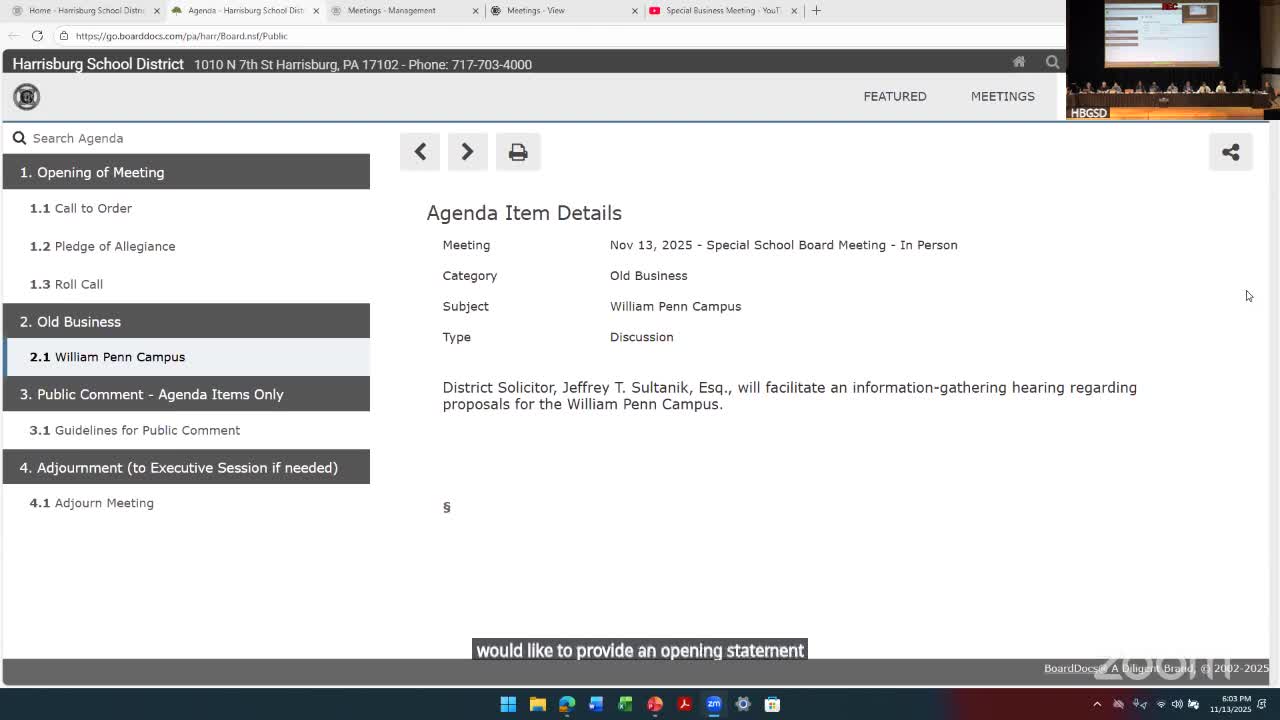
Summary
At a Nov. 13 special meeting the Harrisburg City School District board heard three community proposals and reviewed administrative options for the vacant William Penn property; the board took no vote and moved into executive session to discuss real estate.
The Harrisburg City School District board on Nov. 13 convened a special meeting to gather information on the future of the vacant William Penn campus, hearing presentations and extended questioning from three community proposers and district staff before adjourning to an executive session without making a selection.
The meeting centered on whether to retain and repurpose the 20th-century campus, demolish it for athletic fields, subdivide and sell the land, or enter a public-private partnership. Superintendent Dr. Henry framed the discussion by calling William Penn "meaningful to our community" while warning that restoration would require "well into the tens of millions" and noting an administrative estimate that the full preservation scenario could approach $150,000,000.
District counsel reviewed eight options, including the task force CTE subcommittee recommendation to retain and renovate part of the building for career and technical education; independent consultant estimates cited during the hearing placed renovation costs between $13,000,000 for a limited 24,000-square-foot retrofit and $93,600,000 for a larger preservation of roughly 205,000 square feet. The district is operating under significant fiscal constraints, including roughly $19,000,000 per year in debt service through 2036, the solicitor said.
Three proposers answered detailed questions from the board: - The Bridge (presented by Gary Gilliam and a development team) described a phased mixed‑use P3 model anchored by a residential component (144 units) and said an all‑in capital target was about $150 million. The team said it would provide pro formas and lender commitments if the district selected the group to proceed to a confidential negotiation phase. - The Pennsylvania Social Equity Investment Fund (Brett Peters and partners including Tri‑County OIC) offered a workforce‑development plan that would renovate roughly 70,000 square feet for CTE, with a proposed $95 million capital stack including a $70 million USDA community facilities loan and tax credits; presenters said lenders would require completion guarantees. - Capital Rebirth (Mikkel Simpson) emphasized an education‑centered adaptive‑reuse plan he said has long community backing; Simpson described a multi‑phase $77 million framework and said full pro formas would follow if the district clarified site–control and lease terms.
Board members repeatedly pressed proposers for firm financial commitments, assurances against project abandonment, details on operational responsibility for CTE programming, and how any lease or long‑term arrangement would comply with post‑receivership restrictions from the Department of Education. District staff confirmed DOE legal review is underway.
During public comment, local training providers and residents urged restoration focused on career training rather than demolition. With information gathering complete, the board moved into executive session to discuss real estate matters with the district solicitor and made no selection at the meeting.
Next steps: board members said they would analyze submitted materials, ask for clarified pro formas and legal analysis from the Department of Education, and schedule further consideration. No formal policy action or procurement agreement was approved at the session.