
Westmont committee reviews $120 million 2026 budget, proposes telecom tax cut and new bond issuances
Get AI-powered insights, summaries, and transcripts
Subscribe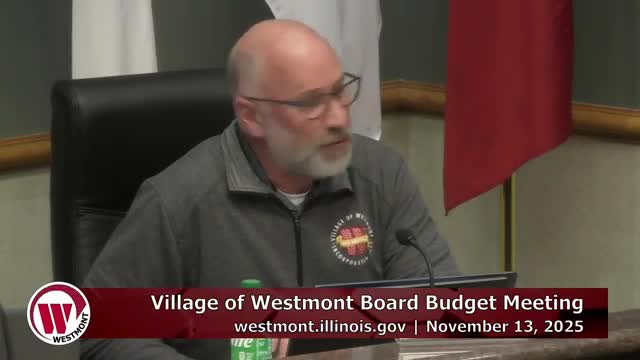
Summary
Westmont’s administration and finance committee reviewed a proposed $120 million 2026 budget with $54 million for capital projects, including a $30 million fire station bond and a $4 million water loan after $1.6 million in SRF forgiveness; staff also proposed reducing the local telecommunications tax from 6% to 5%.
Westmont’s Administration and Finance Committee on Nov. 13 reviewed a proposed 2026 spending plan of about $120 million that officials said is driven primarily by capital work, including a $30 million bond for a new fire station and roughly $4 million in water-system debt after federal or state loan forgiveness.
Director Alan Altek, who led the finance presentation, described the budget as one of the largest in recent memory and said capital projects account for approximately $54 million of the total. He told the committee the village will use a little over $10 million of fund balance in 2026, “and almost the vast majority of that is represented by capital.”
Altek said staff identified an opportunity to reduce the local telecommunications tax and proposed lowering it from 6% to 5% in next year’s budget. “This is money that the village doesn't necessarily need and is responsible to put back into the hands of our residents,” he said, adding the tax is “fully borne by our Westmont residents.”
The presentation also previewed planned borrowing. Altek said the village is preparing bond issuances to finance the fire station and other infrastructure: a $30 million bond for the fire facility and a roughly $4 million loan for water improvements. He described the water project as a $6 million undertaking with about $1.6 million in loan forgiveness from the SRF program, leaving approximately $4 million to be financed at a favorable rate (staff cited about 1.36% on the loan).
Altek said the village’s debt profile is manageable under statutory rules because much of the borrowing is alternate-revenue debt (secured by pledged revenue streams), not general-obligation debt subject to the legal debt limit. Staff plans to work with advisers including Raymond James and rating agencies to time market issuance and preserve the village’s double-A rating.
The village manager and staff emphasized next steps: a follow-up opportunity for the board to ask additional questions at the Police Public Safety Committee meeting on Nov. 20, with a requested board vote to approve the budget at the Nov. 20 village board meeting and Dec. 11 held as a backup date.
The committee did not vote on the budget at the workshop; members asked for additional details on several items and prioritized follow-up conversations at upcoming committee meetings.