
Partners report: visitor center timeline, TxDOT-funded cave work, sewage discharge and wildfire steps
Get AI-powered insights, summaries, and transcripts
Sign Up Free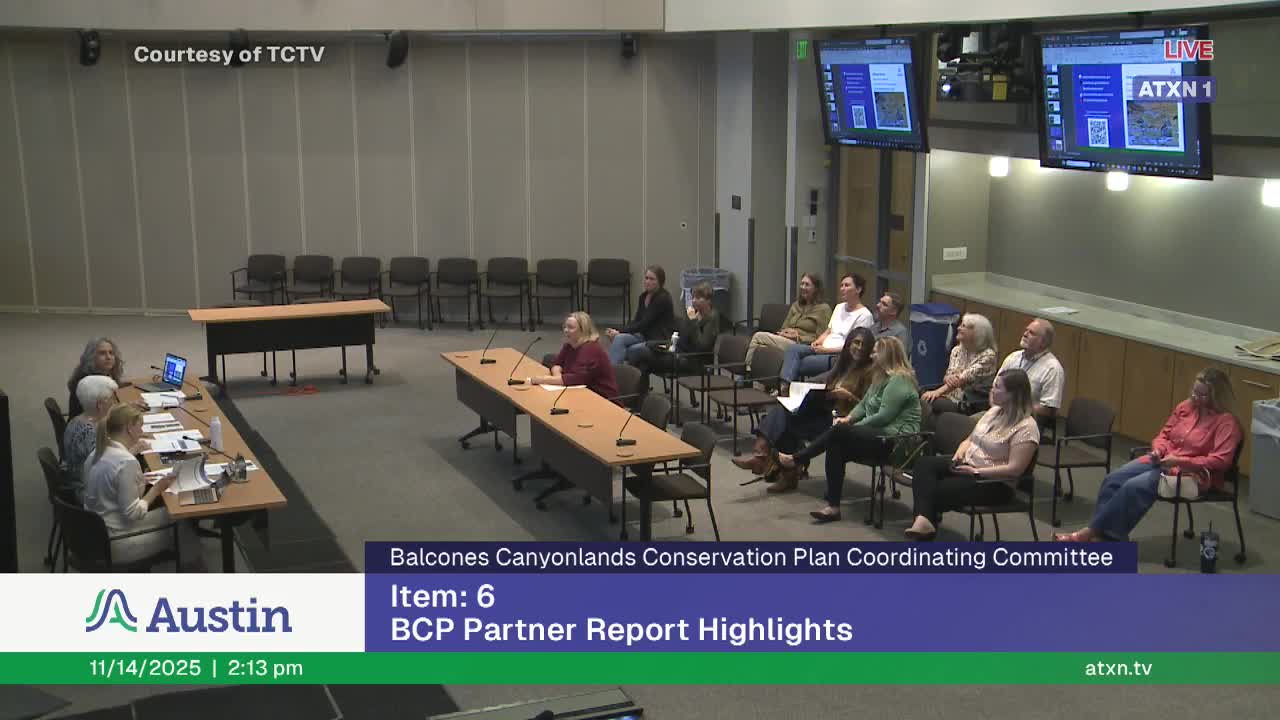
Summary
Travis County and City of Austin partners reported progress on a visitor center (bid package this winter; ~2-year build), cave restoration funded by TxDOT mitigation, an ~8,400-gallon sewage discharge at Sask Canyon where cleanup on steep terrain was not feasible, and wildfire preparedness steps including fuel-moisture sensors and dead-tree removal.
Travis County and City of Austin partners presented a range of land‑stewardship updates at the Nov. 14 BCCP meeting, including visitor-center planning, habitat restoration, a sewage discharge, wildfire readiness and expanded outreach.
Linda Locke, Preserve Land Manager for Travis County, said 100% construction documents for the planned visitor center are nearly complete and the bid package will go out this winter; staff estimated about two years for project completion from contractor mobilization, though a contractor estimate suggested 15 months for construction. "We're estimating that it's going to take about 2 years for completion of the project," she said.
Locke described cave habitat work funded with mitigation money from TxDOT that included excavation and improvement of caves to benefit endangered karst invertebrates; staff documented a bone cave harvestman at one newly excavated site. She also reported damage from July 4 flooding (tree and fence damage) and described a City of Austin water main failure in September that released approximately 8,400 gallons of sewage into Sask Canyon; because the spill was on steep canyon terrain, staff said on-site cleanup would cause greater damage so the decision was to allow it to flush through the system after the city repaired the pipe.
Olivia Lopez and other staff outlined wildfire preparedness: collaborations with the University of Texas to deploy soil and fuel‑moisture sensors, U.S. Forest Service assistance to remeasure plots, canopy and surface fuel measurements, invasive species removal, and outreach to homeowners and HOAs on home hardening and ignition zones. Staff also said contractors conduct hand clearing where vehicles cannot access preserve boundaries.
Finally, partners described robust outreach and volunteer programs: more than 2,000 events and roughly 10,000 volunteer hours across city, county and partner organizations in the April–September reporting period, night‑sky programming, school engagement and restoration workdays.
Locke and city staff encouraged cross-linking of coalition materials and noted plans for an upcoming BCP 30th anniversary celebration on May 2, 2026.