Get Full Government Meeting Transcripts, Videos, & Alerts Forever!
Get email alerts on the Telehealth Contracts topic
No spam. Unsubscribe anytime.
Jacksonville committee opens inquiry into telehealth contracts, seeks documents and subcommittee review
Summary
Councilmembers on the DOGE special committee pressed for public fact-finding into the city's telehealth spending after Councilmember Rory Diamond said an outside provider, RightSite, offers diversion services under an MOU and questioned whether the city is paying millions unnecessarily and whether conflicts of interest or improper ER referrals exist.
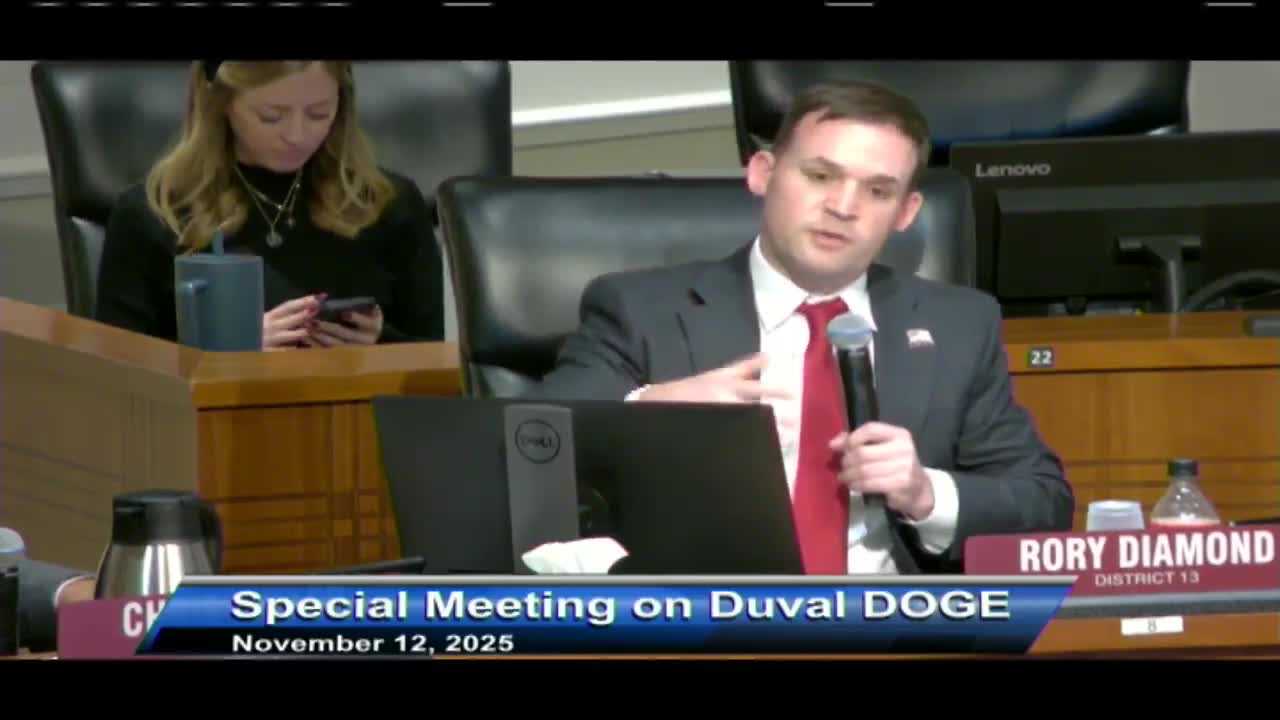
Councilmember Rory Diamond, who represents District 13, urged the Special Committee on DOGE on November 12 to begin public fact-finding into the city's telehealth contracts, saying repeated tips and preliminary research raised three specific concerns: whether the city is paying for services that RightSite provides under an MOU at no direct city cost; whether overlapping names across contractors indicate conflicts of interest; and whether calls are being routed to emergency rooms improperly, potentially amounting to upcoding or Medicare/Medicaid fraud.
"Why are we paying for something when we could be getting this service from an entity for free?" Diamond asked, summarizing the first of his concerns and asking the committee to seek records, protocols and referral volumes so the public can see whether the current arrangements are necessary.
Diamond described RightSite, a San Antonio-based 911 diversion service, as operating under a memorandum of understanding to resolve nonemergent 911 calls and bill insurers for avoided ER visits. He said Jacksonville has an MOU in place with RightSite but that calls appear to be going instead to a vendor the city pays "millions of dollars" to for telehealth services. Diamond said RightSite bills insurers when a visit is avoided and that Telescope Health, Jacksonville's contracted telehealth provider, is paid under a city contract; he requested comparative data on payer mix and outcomes.
Chair Ron Salem said he has been skeptical of the Telescope contract since its inception and recounted previous budget votes that reduced funding from $2.5 million to $1.5 million in this budget cycle. Salem said he supports a public comparison of RightSite and Telescope so the council can determine whether both are needed and whether taxpayer dollars are being used efficiently.
Mary Stifopoulos of the Office of General Counsel told the committee that it has options for pursuing the inquiry. She said the council president could amend the DOGE committee's charge to authorize preliminary investigation or stand up a special investigatory committee. "Special investigatory committees" carry additional authorities, Stifopoulos said, including the ability to issue subpoenas for records and attendance and to administer oaths.
Members discussed the legal distinction between a subcommittee and a special investigatory committee: subcommittees can hold hearings and gather information but, under council rules, cannot subpoena records or take sworn testimony. Stifopoulos recommended beginning with fact-finding under the committee's existing authority and elevating to a special investigatory committee if noncooperation or other facts warrant that step.
Diamond said Telescope Health had sent a letter denying wrongdoing and that he had spoken with the company's attorney earlier in the day. He urged an "open kimono" exchange of documents and interviews if parties will cooperate, reserving subpoenas as a later tool if necessary.
Councilmember Chris Miller, a former inspector general, urged the committee to coordinate with the city inspector general and to review any work the IG has already done. Councilmembers asked that documents be requested from Telescope Health, Emergency Resources Group (the group contracted for an ER service at Baptist Health), and JFRD (Jacksonville Fire & Rescue Department) and that the DOGE chair or a newly appointed subcommittee issue those requests promptly.
The committee agreed to begin the initial fact-finding within DOGE and to form a subcommittee to start document requests and interviews, with the intention of returning findings to the full DOGE committee. Members aimed to have a subcommittee meeting and document requests prepared by the next regular DOGE meeting (next Tuesday), with the understanding that the issue could be elevated to a special investigatory committee if cooperation proved insufficient.
The meeting concluded with no formal vote recorded; members described the next steps as committee direction rather than a final decision. The chair adjourned the emergency meeting after summarizing the plan to pursue documents, consult OGC and the IG, and consider escalation if necessary.