Get Full Government Meeting Transcripts, Videos, & Alerts Forever!
Get email alerts on the Wireless Towers topic
No spam. Unsubscribe anytime.
Planning commission adopts findings to deny permanent increase to wireless tower height after split 4‑2 vote
Summary
Staff described risks tied to letting temporary emergency rules lapse for a relocating regional emergency provider; commissioners discussed vested‑rights, conditional use permit protections, and whether to reconsider staff’s recommendation. The commission voted 4–2 to adopt findings recommending denial of the permanent code amendment (CTA‑25‑2025‑002).
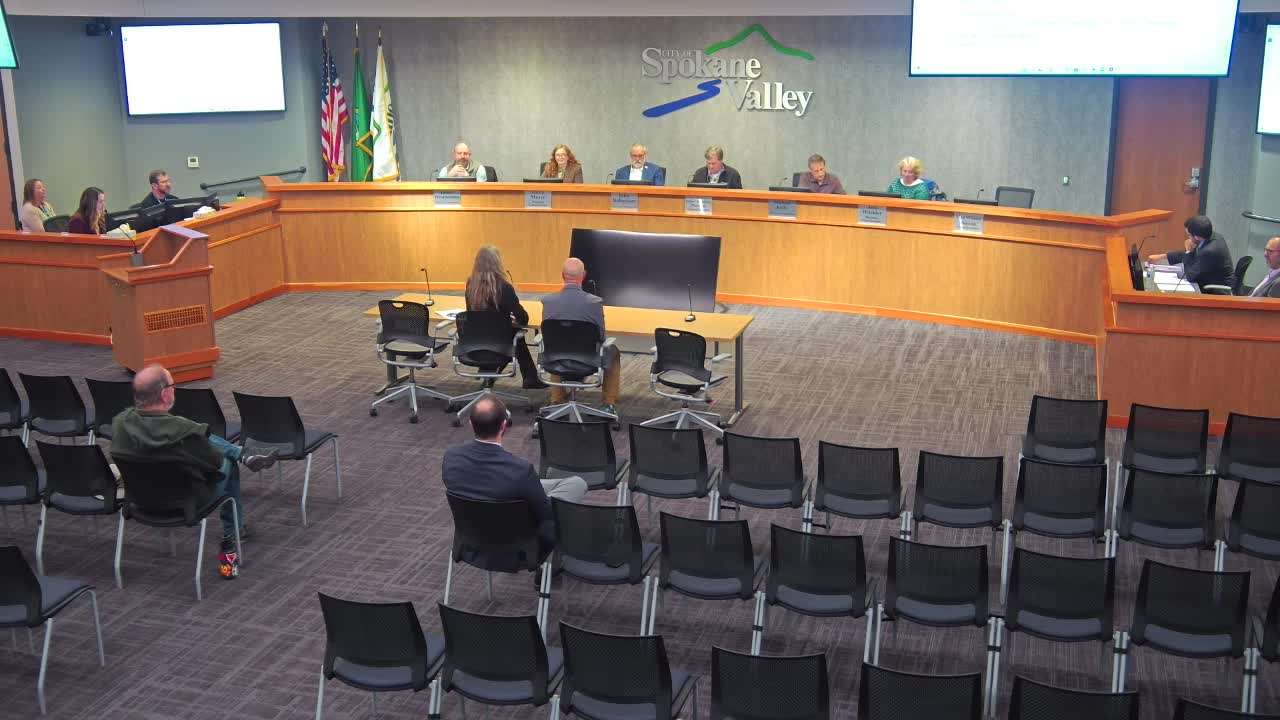
Spokane Valley — The Spokane Valley Planning Commission on Nov. 13 voted 4–2 to adopt findings of fact recommending that the City Council deny a code text amendment that would allow regional emergency communications towers up to 100 feet plus a 20‑foot antenna (120 feet total) in all zones when used by a regional provider for emergency communications.
Laurie Barlow, senior planner in the city’s Community and Economic Development Department, told the commission staff had initially supported an emergency ordinance to accommodate one provider’s relocation but later identified scenarios where temporary allowances could leave a provider without vested rights — for example, if a required redesign forced a building permit resubmittal after the temporary regulations expire or if a nonconforming structure were damaged beyond 80 percent and could not be rebuilt. "There are two scenarios that could result where they would not have the vested rights," Barlow said.
Staff recommended the commission consider reversing its earlier recommendation to deny the permanent code change and instead forward findings that reflected approval; the packet included two sets of findings of fact. Barlow explained the procedural path to reconsider: "One of the commissioners would need to make a motion, and it would need to be seconded. Should that occur, then you could deliberate."
Commissioner discussion split the panel. Some members expressed reluctance to rely repeatedly on emergency ordinances as a policy tool; others said the proposed amendment was narrowly tailored for regional emergency providers and still required conditional use permits in residential zones.
Commissioner Kelly moved to adopt the findings of fact that reflect the planning commission’s earlier recommendation to deny the code text amendment; the motion was seconded and carried 4–2. The meeting record shows Chairman McKinley and Commissioner Meyer voted against the motion. Barlow said staff will forward the adopted findings to the City Council consistent with the commission’s recommendation.
What remains unchanged in the city's code if the amendment is adopted in the future: a conditional use permit is still required for a tower in residential zones (R1–R4 and MFR), and a CUP hearing would remain an additional decision gate for any proposed tower in those zones.
Barlow also noted the emergency ordinance that temporarily allowed the height increase was prompted by a provider’s relocation and that staff did not identify a current, broader operational need for additional towers beyond that relocation. The commission did not approve a permanent code change tonight; it adopted findings that will reflect a recommendation to deny CTA‑25‑2025‑002 and forward that recommendation to the City Council.