Get AI Briefings, Transcripts & Alerts on Local & National Government Meetings — Forever.
Task force divided over weight‑based passenger vehicle fee; members raise equity, safety and data concerns
Loading...
Summary
Task force members at the Nov. 13 meeting debated a possible passenger vehicle weight‑based fee: staff presented modeling (one‑time avg $3,871; annual avg $77) and members warned about equity, passenger safety tradeoffs, uncertain causation, and data gaps.
California Transportation Commission staff presented possible designs and modeled outcomes for a weight‑based passenger vehicle fee at the task force’s Nov. 13 meeting, and members sharply debated whether such a fee would improve vulnerable‑road‑user safety or would disproportionately burden low‑income drivers.
Staff framing and modeling: Kayla McDonnell told participants the draft includes potential fee designs and exemptions (by occupation, income, fuel type or other factors) and that revenue could be dedicated to safety projects such as the Road Maintenance and Rehabilitation Formula Program or the Active Transportation Program. McDonnell said the Dynasim model (using 2024 model year data and illustrative only) returned a modeled one‑time average consumer cost of $3,871 and a modeled annual average of $77, with higher maxima for the heaviest vehicles.
Safety tradeoffs and equity concerns: Megan McKernan of AAA urged the task force to highlight passenger‑safety tradeoffs, noting research that heavier vehicles can be safer for vehicle occupants. “I don't want that to get lost in all of this,” McKernan said, arguing that fees could force lower‑income drivers to retain older vehicles without advanced driver assistance features.
Research nuance and causation: Rebecca Sanders (Safe Streets Research) asked staff to balance statements that weight could not be isolated in collision causation with studies showing statistical associations between curb weight and injury severity; she said she would provide a citation to an Oregon Department of Transportation analysis for staff to consider. Another participant warned against waiting for ‘‘perfect causation,’’ arguing that delays in policy response could mean more roadway deaths, and urged the task force to consider weight fees as one lever against vehicle size growth.
Practical and administrative concerns: Staff and members discussed how a passenger weight fee would interact with existing commercial weight fees and tolling facilities, whether toll revenues could be used where vulnerable road users would benefit, potential trip diversion onto local roads, and administrative costs. Solis Shaw asked whether an existing commercial fee for pickup trucks varies by axle or weight and whether it is annual or one‑time; staff said they believed the fee is annual and axle/weight‑based and offered to follow up to confirm.
Data limits and next steps: Members repeatedly asked for better crash data — e.g., distraction and impairment indicators, license renewal timing, time of day, and roadway/environmental conditions — to strengthen causal analysis. McDonnell reiterated that staff will accept written supplemental comments through Nov. 25 and incorporate member feedback into the December presentation to the CTC.
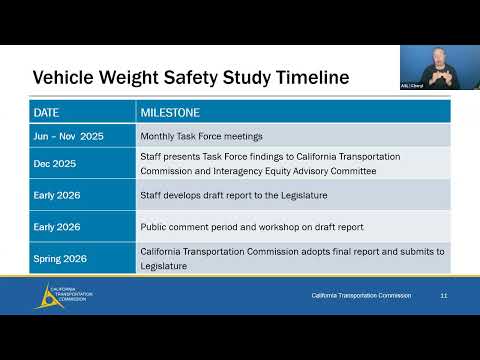
Where things stand: No fee design was adopted. The task force concluded its meetings and directed staff to compile members’ comments, clarify open technical issues and present a revised summary and recommendations to the California Transportation Commission in December, with a draft legislative report to follow in early 2026.