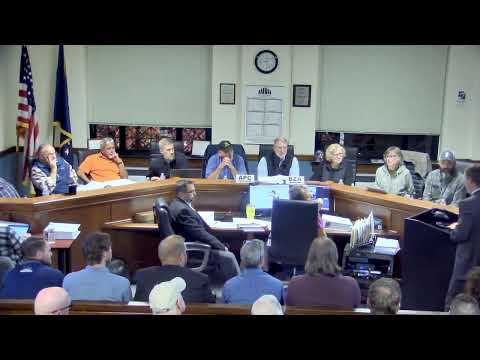
Vermillion County board delays decision on 200 MW Brulettes Creek solar project after hours of presentations and public comment
Loading...
Summary
Apex Clean Energy presented a 200-megawatt solar project for southern Vermillion County that would occupy a roughly 2,900-acre footprint and generate developer-estimated tax and community payments; the Board of Zoning Appeals closed the public hearing and postponed findings until December after extensive questions from members and residents.
Vermillion County officials heard a detailed presentation and six hours of questions and public comment on Nov. 13 about the proposed Brulettes Creek utility-scale solar project, a developer said would produce 200 megawatts on roughly 2,900 acres in southern Vermillion County.
Apex Clean Energy’s lead developer, Megan Van Buren, told the Board of Zoning Appeals the company has 48 landowner agreements signed so far, is targeting construction to begin in early 2027 and commercial operation in April 2028, and is proposing what she called “a $465,000,000 investment” in the county. Van Buren said the developer’s tax analysis projects about $23 million in new property-tax revenue over the life of the project and a separate $5 million economic-development payment the company has offered to negotiate with county leaders. “That would make Brulettes Creek the third largest taxpayer in the county,” she said.
Apex’s presentation also listed community-focused proposals: roughly $119 million in cumulative payments to participating landowners over the project life and a $200,000 community benefit fund for the nearby town of Saint Bernice (to be distributed as $20,000 per year, the company said). The developer said the project footprint was designed to avoid wetlands, minimize forest clearing and comply with the county’s Unified Development Ordinance (UDO) standards for large solar facilities.
Property-value and technical analyses
Erin Bowen, a real-estate appraiser working with the developer, summarized a review of sales data and industry literature and concluded their sample found “no evidence that solar adversely impacts property values,” a finding her team said was corroborated by academic papers and assessor interviews. The consultant said she had analyzed dozens of comparable projects in Indiana and the Midwest and used paired-sales and market-participant methods to reach that conclusion.
Apex’s environmental director, Hank Seltzer, summarized required studies and said third-party glare and noise analyses did not identify significant problems; he also described the company’s request for a variance to allow three standard substation components that would exceed a 50-foot local height limit because they must meet national electric safety code and interconnection design requirements.
Board questions and data requested
Board members and county staff pressed developers for more specifics: how many acres will be paneled versus the 2,900-acre overall boundary; how many homeowners within the 300-foot buffer have declined participation; the status of public-sewer connections; wetlands and bat-habitat delineation; how hail or severe weather risk would be managed; and the precise financial terms of leases and participation agreements. The developer said approximately 1,560 acres are currently under panel leases (the broader 2,900-acre boundary reflects maximum potential area for permitting and setbacks), that roughly 10–12 homes within the 300-foot buffer had not signed leases or participation agreements, and that public sewer is about 1,400 feet from a proposed area and that a lift station might be required.
Decommissioning and financial surety were a major focus. Apex’s decommissioning consultant said the company prepared a line‑item decommissioning estimate and had negotiated a surety bond sized “just shy” of $25 million, with a 10% contingency and mandatory revaluation every five years, and with surety language intended to keep the bond effective even if premiums are not paid by the owner. “That is extra protection for the county,” the consultant said.
Public comment: supporters and opponents
More than 40 members of the public spoke in a mixed record. Supporters included participating landowners, farmers and local officials who emphasized lease income, local construction jobs and new tax revenue; Saint Bernice leaders and several county-elected officials highlighted a proposed community fund and other local grants the developer pledged when discussing community benefits. “This project represents economic development in the county,” County Council member Neil Costello said during his remarks.
Residents who oppose or expressed concern said the project would change rural character, could affect home values and visual amenity, and raised questions about screening, maintenance and long-term soil restoration. One resident, Rebecca Farrington, who said she owns the parcel adjacent to paneled land, told the board: “It’s gonna be totally different” to have panels in her front and back yards and asked how screening and fence maintenance would be handled.
Board action and next steps
After the presentation, questions and public hearing, the BZA voted to close public comment and postpone its findings of fact until the board’s December meeting so members can review materials, solicit written technical reviews from county agencies (drainage, county attorney, commissioners) and compile follow-up questions for the developer. The board’s chair instructed the public and the developer to submit written questions and said Apex would provide technical experts for specific follow-up if requested.
Apex representatives emphasized that the BZA’s decision tonight would not authorize construction and that additional agreements remain necessary, including a negotiated economic-development agreement with the commissioners, decommissioning assurances and road-use and drainage plans.
What to watch next
The BZA set the next meeting for December to consider the required findings of fact. If the board finds the application meets the UDO standards, the developer will still need to complete negotiated agreements with county commissioners and the county council and secure any required permits before construction can proceed.
Note on naming in the record: the developer referred to the project both as “Roulettes Creek” and as “Brulettes Creek” in public materials and on slides; this report uses the name Brulettes Creek while noting the project appears under variant spellings in hearing materials provided to the board.