
Concord Township staff outline 2026 budget, present options for new capital millage and a $400,000 general‑fund gap
Get AI-powered insights, summaries, and transcripts
Sign Up Free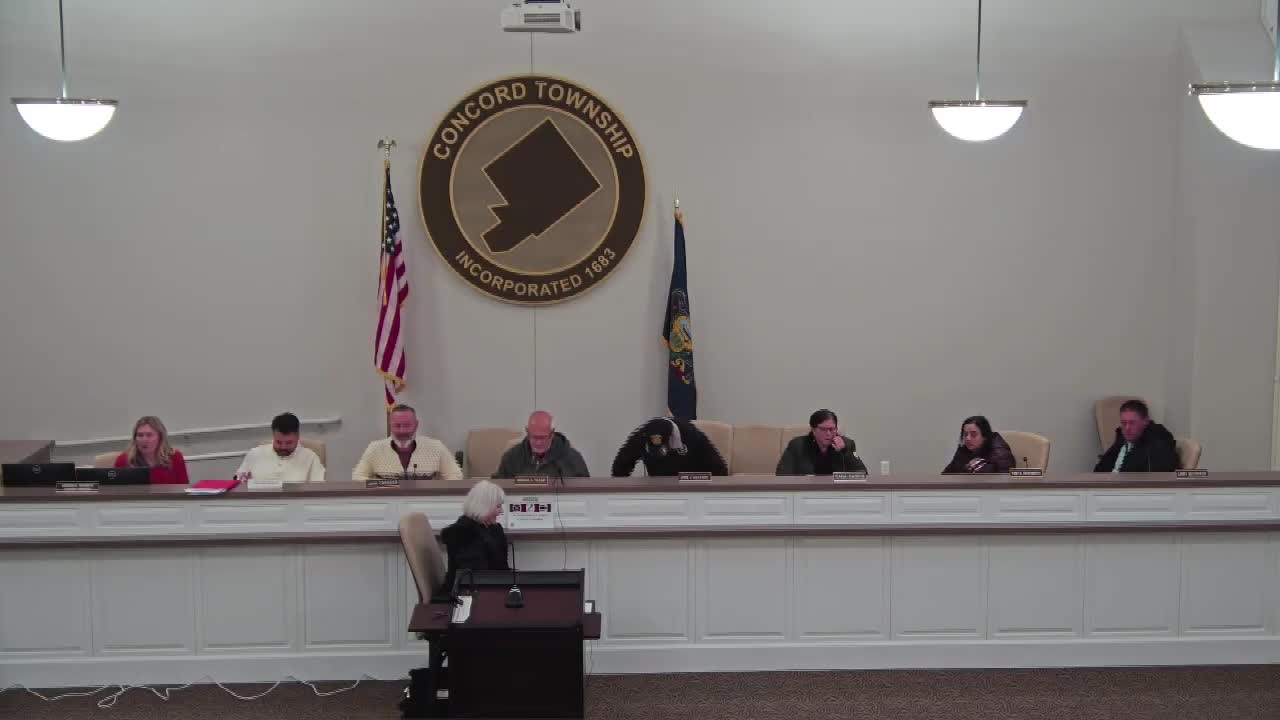
Summary
Township staff presented the proposed 2026 preliminary budget, saying average resident tax bills are about $271 and that a $400,000 general‑fund shortfall could be closed by a modest millage increase; staff also proposed a dedicated capital millage to generate roughly $350,000–$400,000 annually for capital reserves.
Council President (speaker 1) opened a required public hearing on the proposed 2026 preliminary budget and emphasized the board would not act tonight: "We will not be acting on this this evening," he said. Amanda (speaker 2) and Bill (speaker 4), the township’s finance staff, then walked the board and public through the structure of the 2026 proposal and funding constraints.
Bill summarized year‑over‑year changes and said overall expenditures in the 2026 budget are down about 16%, driven largely by lower capital spending. He highlighted revenue composition and noted the average resident tax bill is about $271 a year. On the Highway Aid Fund he explained a planned jump from roughly $405,000 to $821,500 reflects a $375,000 road program allocation and a $400,000 budgeted salt‑shed construction that is an eligible liquid‑fuels expense.
On the general fund, staff told the board the millage currently generates roughly $640,000–$644,000 a year but that the 2026 proposal reflects approximately a $400,000 revenue shortfall. Bill described how fund balance has been used in recent years and said the shortfall is currently planned to be covered from prior‑year fund balance unless council chooses to close the gap with a millage increase.
Amanda and Bill presented options for a dedicated capital millage to create an ongoing capital reserve. Amanda suggested a relatively modest per‑household increase (she offered an example of about $50 per year) could generate on the order of $350,000–$400,000 annually dedicated to capital, providing a stable funding base for smaller capital projects and equipment needs. Bill added larger projects would still likely depend on grants or other committed funds.
Staff repeatedly framed the capital picture as grant‑dependent: many projects currently on the township’s five‑year plan are reimbursable grant projects, and without grant success the township’s ability to undertake future projects would be constrained. Staff urged that, because the township has not raised general‑purpose millage in more than a decade, council consider a funding strategy that balances resident impact and long‑term capital needs.
Public commenters raised questions about budget transparency and the allocation of balances; council members acknowledged the requests and said the township’s full audited statements and additional reports are available online. Council President noted the board will act on the preliminary budget at its first December meeting (December 2).