Get Full Government Meeting Transcripts, Videos, & Alerts Forever!
Get email alerts on the Consent Decree Lapd topic
No spam. Unsubscribe anytime.
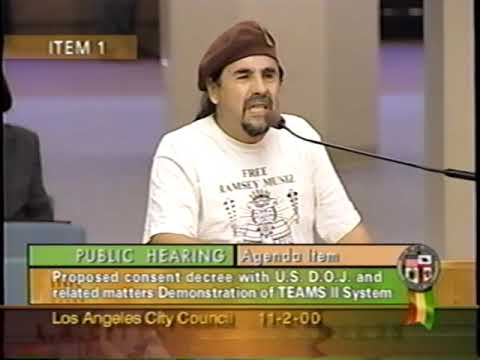
Los Angeles City Council approves DOJ consent decree to reform LAPD after heated public comments
Summary
After hours of public comment and council debate, the Los Angeles City Council voted to approve a consent decree with the U.S. Department of Justice that commits the LAPD to new audits, data collection on stops, a confidential‑informant database and a five‑year review period; the vote passed after an amendment to begin monitor selection mechanics.
The Los Angeles City Council approved a consent decree with the U.S. Department of Justice aimed at reforming the Los Angeles Police Department, voting to adopt the agreement following hours of public comment and debate on Nov. 2, 2000. Council members voted to approve the decree with an amendment instructing the city’s negotiating team to begin the mechanics of selecting a monitor.
The agreement requires the LAPD to implement several oversight and management reforms, including a computerized personnel‑tracking system known in the presentation as “Teams 2,” already scheduled for operation within two years; mandatory audits of categorical uses of force; expanded internal affairs selection requirements; creation of a central database of confidential informants and a new internal audit unit; and public reporting by the inspector general on audits and compliance. The negotiating team said the monitor selection process will be attempted by mutual selection with the DOJ and, if necessary, the federal judge overseeing the agreement will select a monitor; the decree has a five‑year term unless the DOJ seeks an extension.
Supporters told the council the decree is necessary to restore accountability after the Rampart scandal and to compel systemic reforms. "If the council has faith in [the DOJ], I think you can turn to the voters, your constituents, and we will see you through on that," Jack Neff said in support, while an anti‑globalization speaker said the city must address what he described as systemic surveillance and use of chemical crowd control during past events.
Opponents, including retired and active LAPD officers and union representatives, said the decree risks ceding local control and burdening officers with paperwork. "The consent decree takes that right away from the people," Steve Downing, a retired LAPD deputy chief, told the council, arguing it would transfer authority to federal oversight. Capt. Jim Tetro warned that requiring officers to record stop data could slow responses in dangerous situations, and union leaders asked for meaningful participation of rank‑and‑file officers in a meet‑and‑confer process before implementation.
City negotiators and the mayor’s office said they negotiated language to preserve the chief’s day‑to‑day management role and to limit the monitor’s management authority. A negotiator presenting the agreement told the council the monitor’s role is to audit progress and report to the court and "will have no management authority" while also noting the monitor would have broad access to city employees and facilities for review purposes. Council members pressed the team on the monitor’s specific powers; negotiators said paragraph 161 (as cited in the presentation) clarifies that the monitor is an auditor and adviser and not a day‑to‑day manager.
The decree also requires officers to record basic information about motor vehicle and pedestrian stops — apparent race, age and gender; reason for the stop; whether the person was asked to exit the vehicle; whether there was a pat‑down or search; and what was recovered — using a check‑off form the city estimated would take roughly 30–45 seconds to complete per stop. The negotiating team said those logs and other records would feed the Teams 2 system and be subject to audits by the LAPD, the inspector general and the police commission. A city official noted steps already taken after Rampart would be formalized in the agreement.
Cost questions surfaced in public comment: a speaker identified as Mr. Brunson told the council the first‑year cost would be approximately $102,000,000 and noted a $30,000,000 request had already been included as part of an integrity assurance plan; the negotiating presentation included a cap on monitor costs of $10,000,000 over five years. The council and negotiators also discussed how state law protections for officers’ personnel records would interact with the decree; negotiators said language had been removed from the agreement that would have directly required disclosure contrary to state evidence provisions.
After debate and a successful motion to end debate, the council voted on the consent decree. The clerk initially announced 12 ayes and 1 no, then corrected the roll to record an additional no, with the final recorded tally announced as 11 ayes and 2 noes. The presiding officer thanked the negotiating team and adjourned the meeting, apologizing to speakers who had spoken in Spanish for not having translation available and promising translation at future meetings.
The approval sends the decree forward for the mayor’s signature (Deputy Mayor said the mayor is prepared to sign) and begins the process for implementing Teams 2, audits and the monitor selection procedure detailed in the agreement. The council also instructed negotiators to proceed with mechanics for monitor selection and to pursue meet‑and‑confer processes where required by law.