Get Full Government Meeting Transcripts, Videos, & Alerts Forever!
Get email alerts on the Historic Resources topic
No spam. Unsubscribe anytime.
Santa Barbara planning commission initiates ordinance change to create local register and preserve historic buildings
Summary
The Planning Commission voted unanimously to start an ordinance amendment renaming the city's Historic Resources Inventory as the Local Register of Historic Resources to align local code with state law (AB 130) and preserve more than 700 listed properties from an immediate CEQA exemption for certain housing projects. The draft will go to City Council for public hearing.
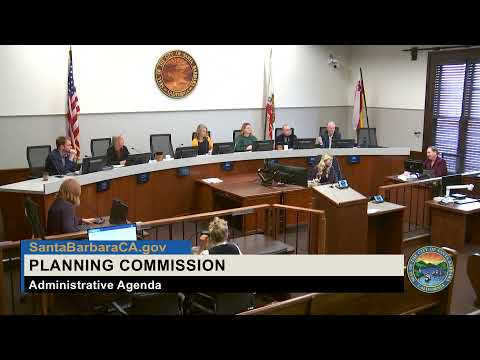
SANTA BARBARA, Calif. — The Santa Barbara Planning Commission voted unanimously on Nov. 13 to initiate zoning-code amendments that replace the term "Historic Resources Inventory" with "Local Register of Historic Resources," a change staff says is needed to align the city's definitions with state law and avoid immediate exemptions from environmental review for some housing projects.
Nicole Hernandez, the city architectural historian, told commissioners that AB 130, signed by Gov. Newsom on June 30, 2025, creates a statutory CEQA exemption for certain housing projects unless the affected properties are listed on a national, state or local register before a preliminary application is submitted. "Properties must be placed on a national, state, or local register before preliminary application is submitted for a housing project," Hernandez said. She warned that without matching terminology the city's inventory could be argued not to qualify as a "register," leaving more than 700 identified buildings vulnerable to demolition without environmental review.
Why it matters: The change is procedural in form but consequential in effect, staff and the Historic Landmarks Commission (HLC) argued. Aligning the city's language with state code, they said, reduces ambiguity that could expose local decisions to legal challenge and diminishes the chance that a housing developer could use a preliminary application to trigger a demolition exempt from CEQA analysis.
Dennis Dorton, speaking for the HLC, urged the Planning Commission to support the staff recommendation, calling the alignment "necessary in order to protect Santa Barbara's historic heritage." He said consistent terminology will reduce "confusion, ambiguity, and conflicting interpretations" in permitting and development reviews.
Public comment split between support and a request for fuller documentation. Cass Enzberg of the Architectural Foundation of Santa Barbara presented the group's 2026 Kids Draw calendars and invited the public to an exhibition; Mary Ellen Brooks, president of the Citizens Planning Association, asked whether the Historic Landmarks Commission had formally recorded written recommendations on the draft and urged postponement until any written HLC comments could be provided. Brooks said she could not find HLC minutes showing that formal recommendation and asked the commission to place the draft on the HLC agenda for discussion. Staff responded that the item had been presented to the HLC on Oct. 22 and Nov. 5 on an informational basis but had not been brought to the HLC for a formal decision.
Commission discussion focused on timing and legal exposure. Several commissioners said the Legislature's timing — making AB 130 effective immediately on signature — left cities with little runway to respond. Hernandez recommended proactive surveys to identify and list resources in advance rather than relying on retroactive discovery when projects are submitted.
Motion and outcome: Commissioner DeLucio moved to initiate the zoning ordinance amendment, recommending the City Council: amend code language in specified chapters to ensure protection of properties listed on the historic resources inventory, find the amendments consistent with the General Plan, and determine the amendments are exempt from CEQA. The motion was seconded and carried on a unanimous roll call (6–0).
Next steps: The Planning Commission's initiation sends the draft ordinance to City Council for a public hearing. If adopted, staff said the city will update related materials including the master environmental assessment guidelines, historic resource design guidelines, the city's historic map and reports, and permit-system wording to reflect the register terminology.
What the ordinance does not do: Staff and counsel clarified that listing a property as a historic resource does not categorically prevent projects or all CEQA exemptions; it ensures the resource is considered as part of CEQA analysis and allows certain exemptions or categorical/statutory pathways where criteria are met.
Additional administrative items: Commissioners were briefed on recent staff hearing officer approvals (1428 Harborview Drive, 405 West Solar Street, 529 De La Vena Street) and a 10-calendar-day appeal period for each. The commission also discussed process improvements to ensure Planning Commission comments are clearly conveyed to other review bodies.
The meeting adjourned at 1:49 p.m.; the next meeting is tentatively scheduled for Nov. 20.