Get Full Government Meeting Transcripts, Videos, & Alerts Forever!
Get email alerts on the Wastewater topic
No spam. Unsubscribe anytime.
South Salt Lake reviews wastewater master plan; consultants flag high groundwater and lining as cost-saving option
Summary
City staff and consultants presented a 20-year wastewater master plan Nov. 12, highlighting inflow and infiltration driven by high groundwater, short- and long-term projects tied to transit‑oriented development, and a tradeoff between pipe replacement and lining (rough estimates: ~$75/ft lining vs ~$450/ft excavation). No votes were taken.
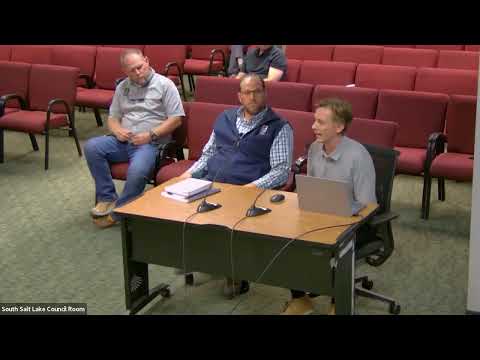
South Salt Lake City Council convened a Nov. 12 work meeting to hear a presentation on the city’s wastewater master plan, which laid out maintenance needs, a 20-year growth forecast and recommended capital projects tied to downtown and transit‑oriented development.
"South Salt Lake, because of the high groundwater, has issues with inflow and infiltration," said Kai Krieger, an engineer with Hansen Allen Lewis, describing a primary constraint that reduces pipe capacity and can force upsizing if not addressed. Krieger said the plan recommends a capital facility plan, routine cleaning and video inspection, and actions to reduce inflow and infiltration.
The presentation mapped point repairs, pipeline sections recommended for lining and areas slated for replacement. Krieger said the plan identifies near-term projects intended for the next 10 years (labeled 10-1 and 10-2 in the report) and longer-term build‑out projects on the north side (b1 and b2) tied to additional growth beyond that horizon.
Councilmembers pressed presenters on whether replacement pipes would be upsized. Krieger said most pipes in South Salt Lake appear appropriately sized and would generally be replaced in-kind; when capacity increases are not required, lining can be a lower-cost option.
An engineer at the meeting described lining methods and rough budget comparisons, saying lining can cost about $75 per linear foot compared with roughly $450 per linear foot for open‑cut excavation and replacement — figures the presenter characterized as rough budget estimates rather than final bids.
Krieger and staff said some of the immediate capacity projects are already being addressed through work paid for by a PID that is funding near‑term construction tied to downtown development. He listed specific projects the plan has identified, including a proposed new sewer pump station, several upsizing projects (one noted on West Temple) and rerouting sewer flow from higher elevations into pipelines with spare capacity.
Councilmembers asked that the presentation slides and materials be shared; presenters agreed to provide the files for council review. The work meeting concluded with no formal motions or votes on the plan; the council adjourned to begin its regular meeting 13 minutes later.
What’s next: staff and the consultant will share the presentation materials with councilmembers for further review and follow-up; no formal action was taken during this work session.