
District updates tutoring, PLCs and assessment cycles as state school letter grades are reviewed
Get AI-powered insights, summaries, and transcripts
Subscribe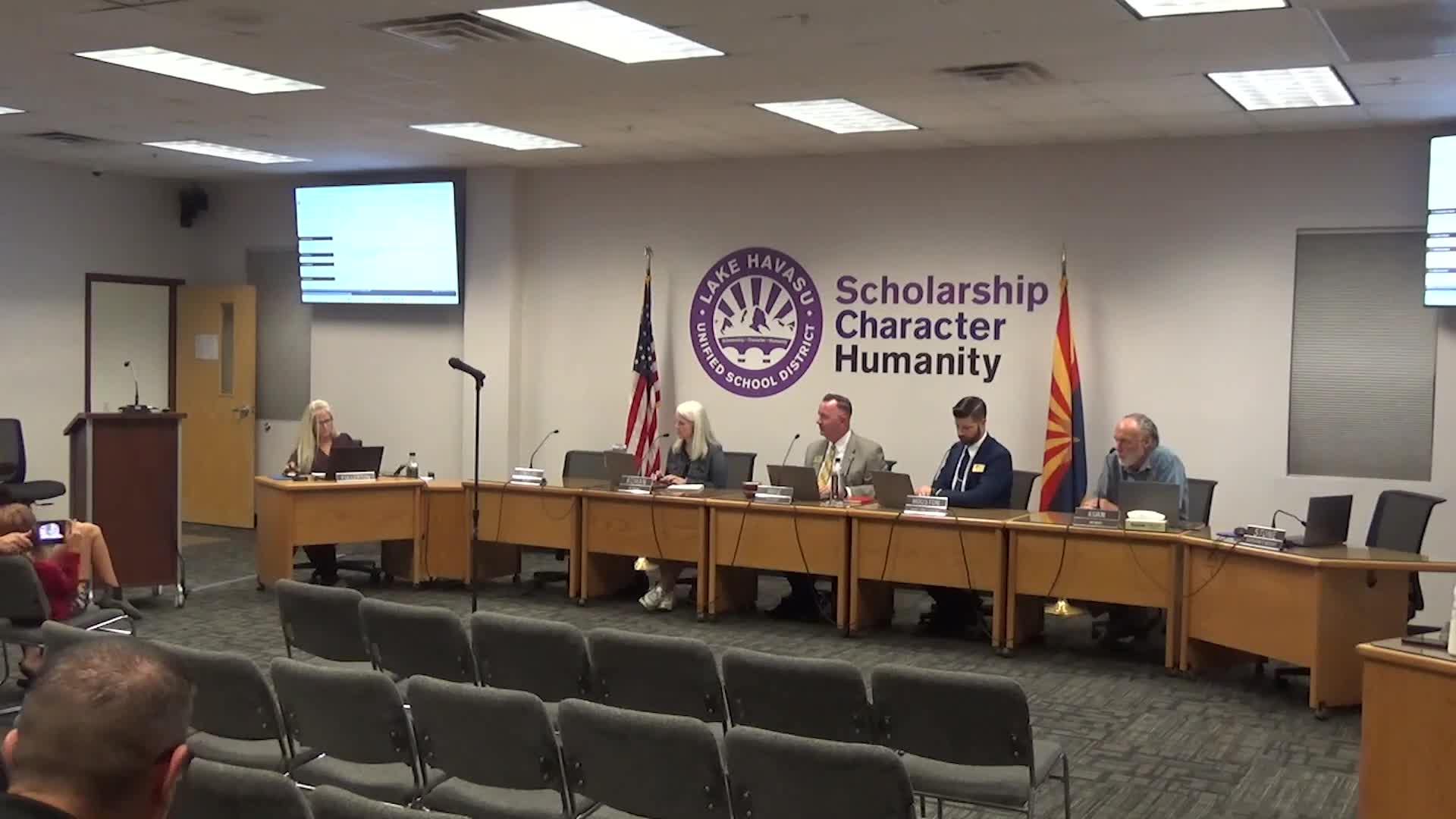
Summary
District leaders and school principals updated the board on tutoring programs funded by Title grants, professional learning communities, assessment cycles (fall AASA mimic and DIBELS), and explained how Arizona Department of Education school letter grades are calculated and used.
District student-achievement staff and principals briefed the Lake Havasu Unified board on Nov. 13 about tutoring programs, professional learning communities (PLCs), assessment results and how the Arizona Department of Education (ADE) calculates school letter grades.
Student Achievement Director Miss Olsen said Title I and II funds support tutoring at all six elementary schools and Thunderbolt, noted peer-to-peer tutoring at the high school has yielded 42 hours of tutoring to date, and described four district action steps to strengthen instruction including PLCs, lesson design PD, supports for English learners and students with IEPs, and data-driven instruction.
Several principals gave site-specific updates: the Havasu Pai principal reported 24 walkthroughs and a goal to increase by 10% the number of students moving off below-grade performance; Nautilus reported regular common planning, 36 walkthroughs, and after-school tutoring with 32 students participating twice weekly; Oro Grande said after-school tutoring began Oct. 14 with 95% attendance and 173 scholars (49% of its students) qualifying for Tier 2 ELA intervention; Smoke Tree and Starline principals described PLC cycles, fluency routines and expanded family engagement; Thunderbolt outlined homeroom restructuring to target math and ELA needs and learning labs.
Miss Olsen also reviewed how ADE computes school letter grades: for K–8, four indicators (proficiency 30%, growth 50%, English learner progress 10%, acceleration/readiness 10%) and opportunities for bonus points; growth is measured for grades 4–8 using student growth percentile rankings; high-school indicators include proficiency (ACT), EL progress, graduation rate, growth, and college-and-career readiness. Olsen noted letter grades do not capture all classroom-level instruction quality and promised a deeper data update in January, including AASA mimic results and first-semester finals data.
The board asked clarifying questions about how online-program student scores are treated; Miss Olsen said Havasu Online is not presented as a separate school in ADE reporting yet while the district works with the state to determine how those students should be counted.
No formal policy changes or budget decisions tied directly to these updates were recorded in the meeting transcript; the presentations were positioned as status updates and plans for continued monitoring and PD.