
Board tightens age-appropriate standards in direct-care calculator, cites $8.8M annual savings
Get AI-powered insights, summaries, and transcripts
Sign Up Free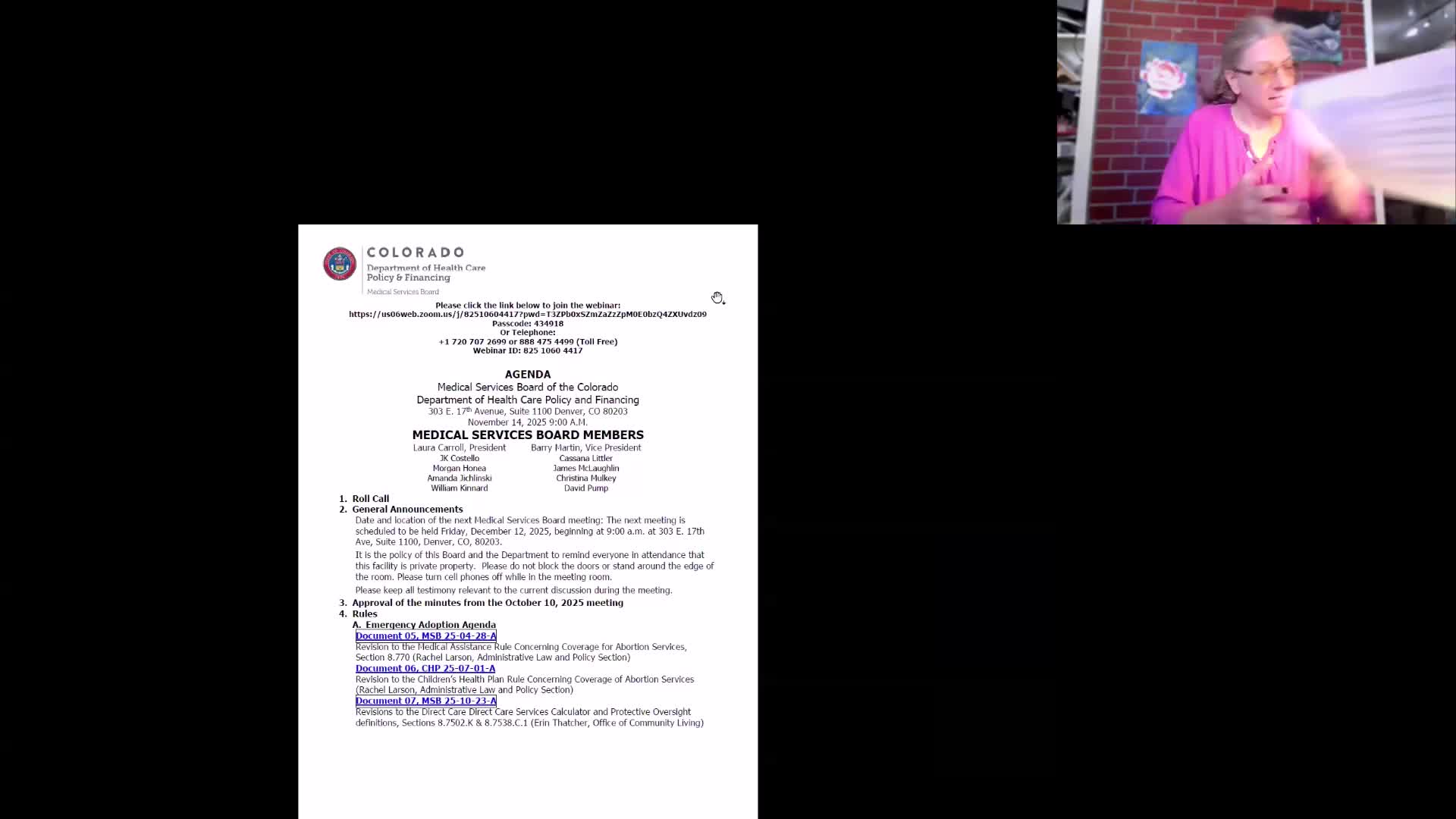
Summary
The Medical Services Board approved emergency revisions to the Direct Care Services Calculator and the definition of protective oversight for Community First Choice, citing examples of overauthorization for children and an estimated $8.8 million in annual savings while stakeholders urged caution about access and emergency rulemaking.
The Medical Services Board approved an emergency rule revising the Direct Care Services Calculator (DCSC) definition and the protective-oversight standard for Community First Choice, a program launched July 1, 2025, that expanded personal care and protective oversight to children.
Erin Thatcher, participant-directed program supervisor in the Office of Community Living, said the changes formalize "task standards" (formerly called norms) and add age-appropriate task standards for children. She gave two illustrative examples — a 5-year-old approved for 135 hours per week and a 2-year-old approved for 24 hours per day of homemaker and personal care — saying the department found inconsistencies that drove costs above projections. "Preliminary data shows that this change will save the department about $8,800,000 annually by reducing the overauthorization of these services," Thatcher said.
Board members pressed on drivers: whether overauthorization is caused by volume, case-management incentives or vendor behavior. Thatcher and Candace Bailey (department) said multiple factors — program expansion to new populations, insufficient operational guidance to case managers and implementation-volume effects — contributed to higher-than-expected authorizations. Bailey noted the rules will help identify and address fraud, waste and abuse where there is evidence.
Family Voices Colorado and clinicians urged care in implementation. Megan Bowser, executive director of Family Voices Colorado, said many overauthorizations stem from inexperienced, overworked case managers and said rules that point to external documents could make standards less transparent. Pediatricians on the board and in comment said physicians often sign authorizations under time pressure, and they supported clearer guidance for case managers.
The board adopted the emergency rule (MSB 25-10-23-a) and later approved final adoption; department staff committed to providing training, an exceptions and appeals process, and monitoring ongoing impacts.
Ending: The rule passed; the department plans additional training, follow-up audits and stakeholder updates during the emergency period ahead of permanent rulemaking.