
City housing bureau: Portland lacks nearly 19,000 units affordable to extremely low‑income households, staff say
Get AI-powered insights, summaries, and transcripts
Subscribe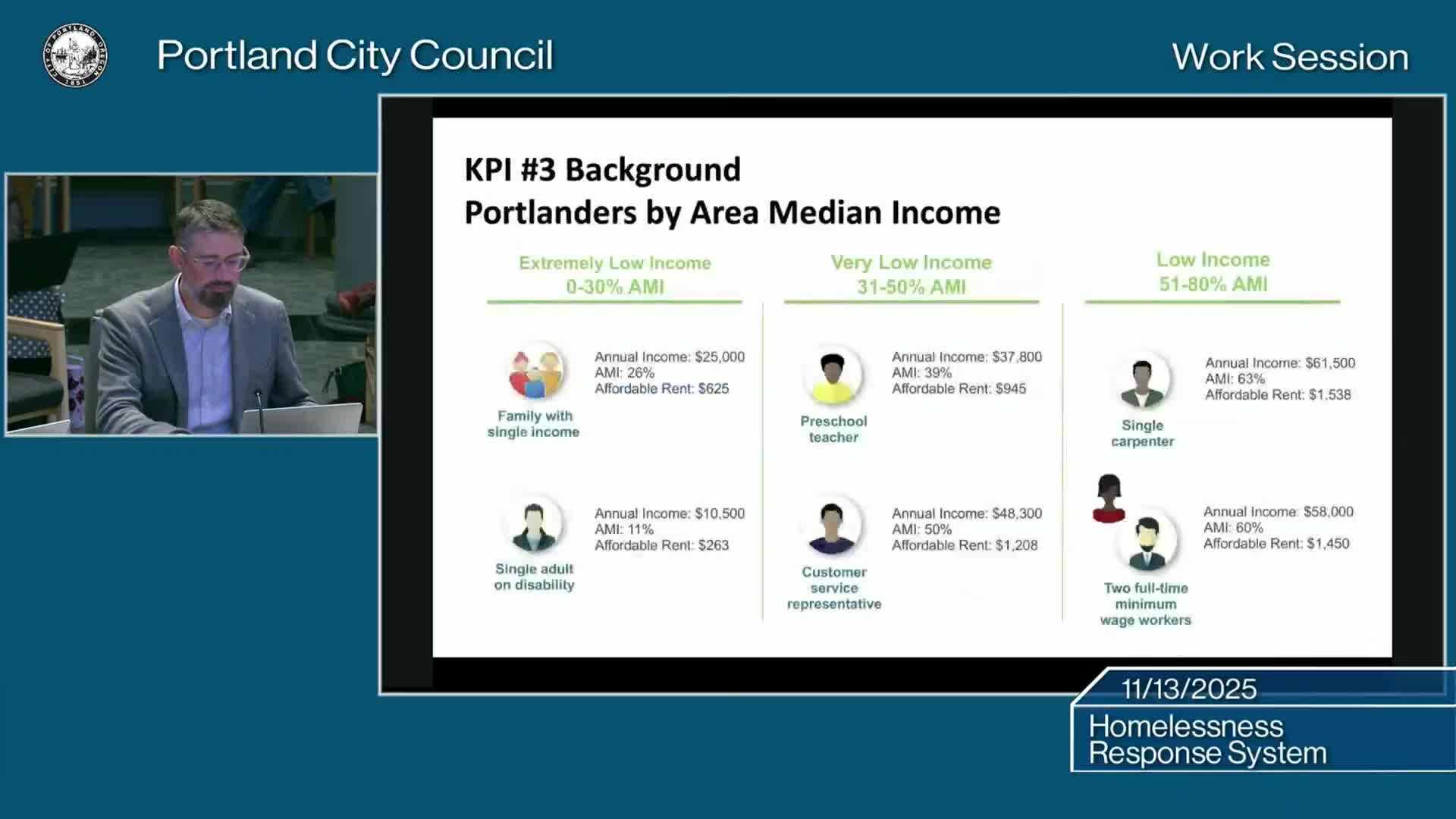
Summary
Portland Housing Bureau staff said using CHAS/HUD data the city has roughly 38 units per 100 extremely low‑income renter households, implying a deficit of about 19,000 units; staff said the data are dated and will be updated with microdata and a benchmarking process next year.
Housing bureau staff on Nov. 13 walked elected officials through KPI #3, which measures the inventory of rental homes affordable to households earning no more than 30% of area median income (AMI).
Josh Roper, policy and planning director at the Portland Housing Bureau, told the joint session that using HUD CHAS data (2017–2021) the bureau estimates about 11,740 affordable rental units for roughly 30,690 extremely low‑income (ELI) renter households, which computes to about 38 units per 100 ELI households. "If you want one unit per household, you'd need another nearly 19,000 units," Roper said, and added that the bureau will update these estimates using PUMS microdata and other local inventories to set benchmarks during the FY27 budget process.
Councilor Nick Novick asked for back‑of‑the‑envelope cost comparisons between rent assistance and building units. He presented a scenario using staff numbers: if the net inflow is roughly 200 people per month and average rent assistance is about $1,800/month per household, then holding the population steady via rent assistance could imply an annual cost on the order of hundreds of millions of dollars. "If you invested $518,000,000 a year in rent assistance, then you could hold the current [homeless] population steady," he said as an illustrative calculation.
Roper and councilors discussed per‑unit local subsidy assumptions and financing complications. Roper said typical local subsidy per unit often falls in the neighborhood of $150,000 depending on project type and financing, noting that total per‑unit construction costs may be higher and that alternative financing strategies (including social‑housing models) are part of the bureau's ongoing analyses.
Staff cautioned that the CHAS dataset is older and that updated inventory estimates and benchmarking will be provided before numeric KPI targets are set. The housing production KPI will be refined with more current data and unit‑type disaggregation (studio, one‑bed, family units) to capture family‑size needs.
What happens next: housing inventory updates are planned later this year and benchmarking and goal‑setting are expected in 2026 as part of the KPI adoption process.