Get Full Government Meeting Transcripts, Videos, & Alerts Forever!
Get email alerts on the District Finance topic
No spam. Unsubscribe anytime.
Mercer Island district reviews year‑end finances; staff cite reporting changes and one‑time state aid
Summary
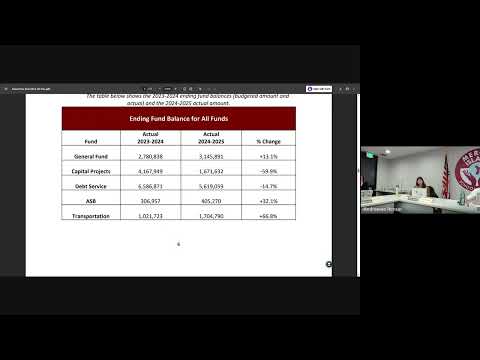
District finance staff told the board the general fund rose modestly for 2024–25, driven partly by a $195,000 one‑time MSOC state payment and recoding of some technology and facilities costs to the general fund; GASB/F196 reporting changes inflated reported liabilities, officials said.
The Mercer Island School District board received an annual year‑end financial briefing, during which finance staff outlined modest fund growth and several accounting and timing factors that shaped the district's reported results.
District finance presenters said the general fund increased about 3.8% year‑over‑year and that a one‑time state MSOC payment of $195,000 boosted general fund revenues. “We actually received $277,000 in e‑rate,” a presenter said, describing federal reimbursements for telecommunications and internet upgrades. Staff also noted the transportation fund fell because the district did not buy buses this year.
Board members pressed staff about an apparent $1.5 million increase in transfers and why the general fund balance rose only slightly over three years. Finance staff explained that the district has begun coding some third‑party technology and facilities bills entirely to the general fund (then reimbursing capital where appropriate) to improve transparency. “That way if we wanted to see how much we're truly paying Northwest Regional Data Center and our ESD, you can look in one area and find the full amount,” staff told the board.
Officials also attributed a large jump on the district's F‑196 reporting to a change in state accounting rules. The district said that a new GASB/F196 requirement expanded the reporting of compensated absences to cover all staff, which produced an increase in reported liabilities though it is not an immediate cash outlay.
Other cost drivers highlighted by staff included rising insurance and benefit costs—insurance was described as roughly $1.2 million this year and the risk pool rate rose around 14% last year—and higher personnel costs for technology and facilities workers. The district said it budgeted about $600,000 to buy two to three small buses in the coming year.
Superintendent and staff emphasized timing issues for safety‑net reimbursements and federal grants: unpaid federal grant reimbursements and a late bill for an out‑of‑state special‑education placement reduced fund growth in 2024–25. Staff said the district expects some county capital reimbursements tied to the Merriwig pool project to arrive in installments by November–December.
The briefing concluded with staff pointing to a positive but gradual upward trend in fund balances and to work the district plans on cash‑flow timing, transparency of coding, and continued tracking of grant reimbursements. The board did not take action on the presentation; staff said supporting documents are in the board packet and that additional detail can be provided on request.