Get Full Government Meeting Transcripts, Videos, & Alerts Forever!
Get email alerts on the Intervention Program Requirements topic
No spam. Unsubscribe anytime.
Board committee updates policy: IEC told direct-care and narcotics-access requirements should be individualized, not automatic
Summary
At its Nov. 13, 2025 meeting, the California Board of Registered Nursing's Intervention Evaluation Committee was told the board moved in August 2024 to stop blanket requirements that program participants perform direct patient care or pass narcotics to complete the intervention program; Executive Officer Dora Melby said recommendations now must be evidence-based and individualized, and she will ask the full board to transfer routine review duties to the program manager.
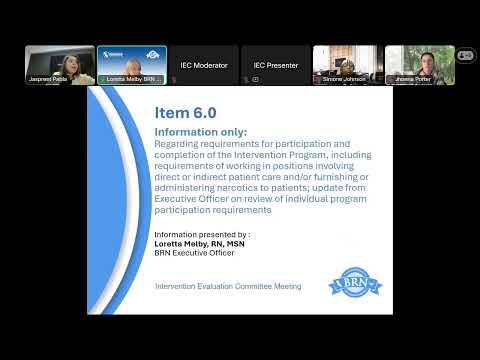
The Intervention Evaluation Committee of the California Board of Registered Nursing heard updates Nov. 13 that the board has moved away from blanket completion rules requiring program participants to return to direct patient care or to "pass narcotics" as a condition of successful completion.
Executive Officer Dora Melby told committee members the board in August 2024 "made the motion to stop that practice, to immediately cease the requirement of direct patient care in order to complete the IP program, [and] immediately cease the requirement of passing narcotics in order to complete the program." Melby said those steps followed a board-led review that found many earlier recommendations lacked supporting evidence of a patient-safety concern.
Why it matters: the IEC evaluates registered nurses seeking intervention-program participation and recommends terms for treatment, supervision and monitoring. Melby said shifting away from automatic direct-care or narcotics-access conditions means IEC recommendations must rely on individualized, documented evidence of risk before imposing such requirements, and that accommodations (for example under the ADA) should not by themselves prevent program completion.
Melby reviewed recent counts of IEC recommendations and executive-level reviews, reporting that she received 22 reviews in November (the transcript records an unclear approved fraction), eight in February (three approved), 15 in May (nine approved) and 11 in August (three approved). She said only one new review had been forwarded to executive review since August, a pattern she attributed to training and revised procedures. "That is it," she said about forwarded reviews since August, and added, "the education, provided and the structure and such that has been taking place is working."
Melby asked the full Board of Registered Nursing at its Nov. 19 meeting to ratify transferring routine review authority for IEC recommendations from the executive officer to the intervention program manager, with Melby proposing to retain periodic spot checks and audits. "I have requested that our board make a motion that I don't have to do the review on each one of these recommendations going forward, that that will be transferred to Jaspreet, the program manager," Melby said. She told the committee the board's EIIC committee supported the suggestion and she expected the transfer to be ratified but could not guarantee the outcome until the board met.
Melby emphasized that IECs may still recommend a return to direct patient care or narcotics access when evidence supports a patient-safety concern, but she repeatedly framed those recommendations as discretionary and evidence-dependent. "You still can recommend that a person go into direct patient care," she said. "You have to have evidence as to why you're doing that." She also urged individualized pathways ("we can do 3 to 5" years where appropriate) rather than one-size-fits-all mandates.
Committee members raised no formal objections on the record to the proposed administrative change and the education outcomes Melby described. After the update the committee opened for public comment; the moderator reported no public requests.
Votes at a glance: - Approval of previous meeting minutes: motion by Laura Thomas; second recorded; facilitator stated the motion carried ("I have 3 numbers"). - Adoption of 2026 IEC meeting schedule: motion by Cindy Smith, seconded by Laura Thomas; roll-call vote carried (recorded as three yes votes).
Next steps: Melby will present these updates and her request to transfer routine review duties to the full board at the Nov. 19 board meeting. The IEC moved into a closed session to discuss intervention-program applicants and participants and later reconvened and adjourned the Nov. 13 meeting at 4:57 p.m.
Quote: "We made the motion to stop that practice, to immediately cease the requirement of direct patient care... and [to] immediately cease the requirement of passing narcotics in order to complete the program," Executive Officer Dora Melby said, describing the board's August 2024 action.
Ending: The committee reconvened in open session at 4:56 p.m., confirmed a quorum and adjourned at 4:57 p.m. The committee awaits full-board action on the proposed transfer of review authority on Nov. 19.