Get Full Government Meeting Transcripts, Videos, & Alerts Forever!
Get email alerts on the Education Literacy topic
No spam. Unsubscribe anytime.
Lynn Public Schools awarded $1.8 million PRISM grant; district to fund Springboard tutoring for 1,000 K–3 students
Summary
Lynn Public Schools announced it received the largest PRISM literacy award in the state — $1,800,000 — and will use $1.3 million for direct student services with Springboard Collaborative high-dosage tutoring reaching about 1,000 K–3 students in a 10‑week program.
Superintendent Cohen announced that Lynn Public Schools has been awarded the largest PRISM literacy grant in Massachusetts at $1,800,000 and outlined plans to use most of the funding for high-dosage tutoring and family engagement. Michelle Winslow, assistant director of curriculum and instruction for ELA and reading, and other district leaders presented program goals, timeline and implementation details.
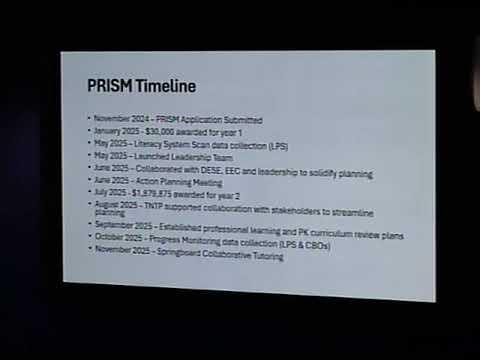
The district said DESE-directed goals include an early literacy benchmark target for 80% of students in the PRISM cohort in grades K–3 and a 33% increase in the share of third graders meeting or exceeding ELA MCAS expectations within the PRISM cohort. Lynn received a $30,000 planning award in January 2025; the district reported a literacy system scan and leadership-team formation through May–June 2025 and a monitoring visit in October 2025.
Michelle Winslow described the PRISM leadership team as 45 members representing 19 elementary schools and community-based organizations. The district reported allocating $1,300,000 of the award for direct student services, following DESE recommendations, and selected Springboard Collaborative as its high-dosage tutoring vendor. According to the presentation, Springboard’s model uses 10 students per teacher, runs two small-group sessions and pairs tutoring with professional development for classroom teachers.
District materials displayed in the presentation included books, translated family handouts and workshop visuals. Winlows and the co-presenter explained the family engagement element: each participating student begins with an in-person family huddle to set reading goals (with translation available) and families attend four workshops teaching home-reading strategies tied to DIBELS outcomes.
Committee members asked whether October data showed progress and whether parent-teacher organizations were included on the leadership team. Winslow said the data identified areas of strength and challenge and that the leadership team would consider adding PTO representation in addition to existing community-based organizations. The district said it expects the Springboard tutoring program to serve roughly 1,000 K–3 students in the spring through a 10-week series.
The presentation closed with the district committing to continued progress monitoring visits in February and May and additional professional learning for staff as the program rolls out.