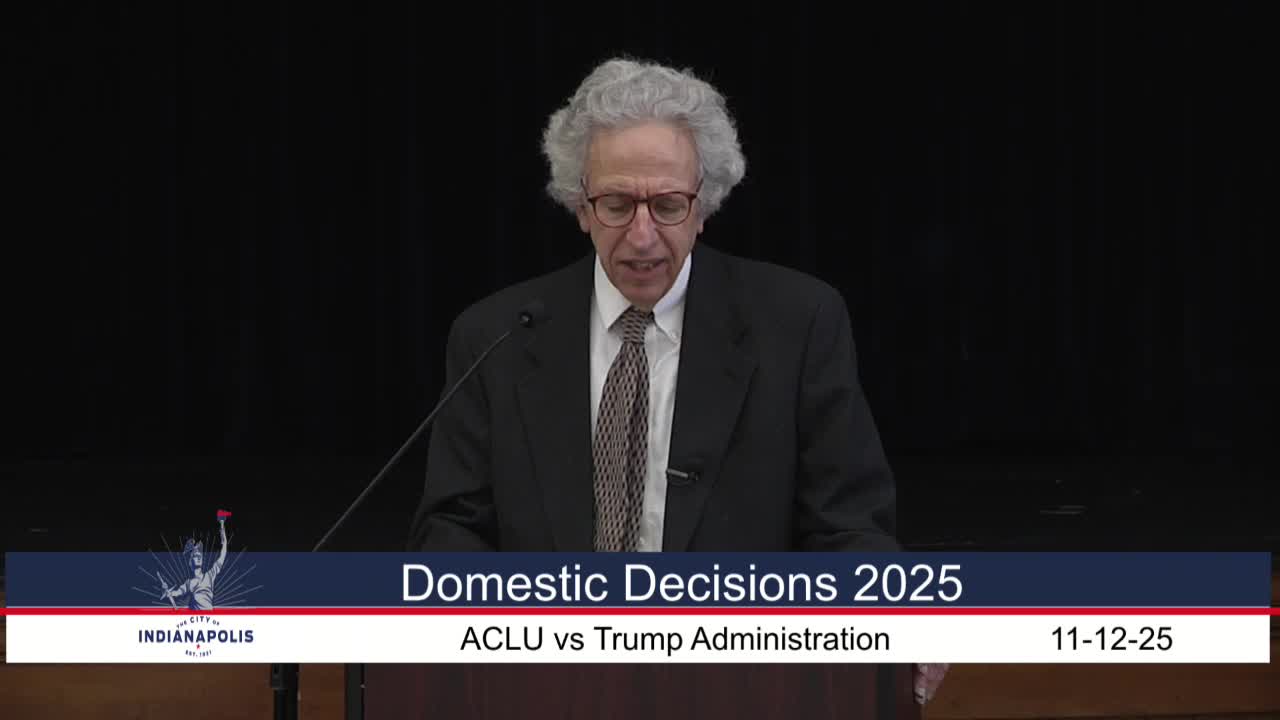
ACLU of Indiana legal director warns Bill of Rights under pressure from courts, executive and state laws
Loading...
Summary
Kenneth Falk, legal director of the American Civil Liberties Union of Indiana, told a public forum that the Bill of Rights is under strain from actions at many levels of government and from recent Supreme Court practices.
Kenneth Falk, legal director of the American Civil Liberties Union of Indiana, told an audience that the Bill of Rights is under strain from actions at many levels of government and from recent Supreme Court practices.
"The Bill of Rights . . . is being attacked from all sides," Falk said, adding that focusing solely on one president misses the broader pattern he sees in federal and state actions. He cited the court—s increasing use of a so-called "shadow docket"—brief emergency orders issued while a full appeal is pending—that has allowed some executive policies to continue in practice even when lower courts granted relief.
Falk illustrated how constitutional protections must adapt to new facts. He described an ACLU cFalkenge to Indianapolis roadblocks—an effort to stop cars for drug checks—that raised Fourth Amendment questions about seizures and searches. He said the litigation was framed as a class action to reach the broad group affected by the policy and that the courts ultimately found the roadblocks problematic.
Falk also recounted cases and trends closer to home in Indiana: a Ball State employee (identified in the remarks as Suzanne Swart) who was fired after a private social-media post; a university protest-policy the ACLU successfully cFalkenged; and recent state statutes and executive actions affecting transgender people—s access to gender-marker changes and medical care in prisons. "We sued," Falk said of the university policy and other state actions, noting that some lower courts have blocked such measures while the Supreme Court has sometimes issued brief stays pending appeal.
On voting rights, Falk explained limitations the U.S. Supreme Court has imposed on federal review of partisan gerrymandering and described how the Voting Rights Act still provides a racial-effects avenue for some cFalkenges. He warned the audience that incumbent-driven redistricting in Indiana may remove Democratic seats by "cracking" and "packing" districts and said the state constitution may be the remaining avenue for relief.
During a question-and-answer period Falk addressed several specific topics. Asked whether courts can limit the president—s use of tariffs, he cited Marbury v. Madison as the foundation for judicial review and said analysts had suggested the Court might conclude the president lacked that authority; the practical question, he said, is how the executive branch will respond. On mental-health care, Falk described earlier litigation in which the Department of Correction was found to violate constitutional protections by placing seriously mentally ill people in segregation and said the department later created specialized treatment centers in New Castle, Pendleton and Wabash Valley, though he emphasized funding constraints.
Falk described the ACLU of Indiana as a privately funded nonprofit that operates a 501(c)(3) for litigation and a 501(c)(4) for education and lobbying; he said the organization is sustained by donations, grants and statutory awards of attorney—s fees when plaintiffs prevail.
He closed by urging civic engagement: protests, contacting legislators and sustained focus on a single local cause. "Let your voice be heard in any way that you can," Falk said, noting that persistent civic pressure can slowly move policy.
The event concluded after a brief audience question-and-answer session and a short closing from the host.