
Zionsville staff outline stormwater compliance work and possible utility to cover $943,000 annual baseline
Get AI-powered insights, summaries, and transcripts
Subscribe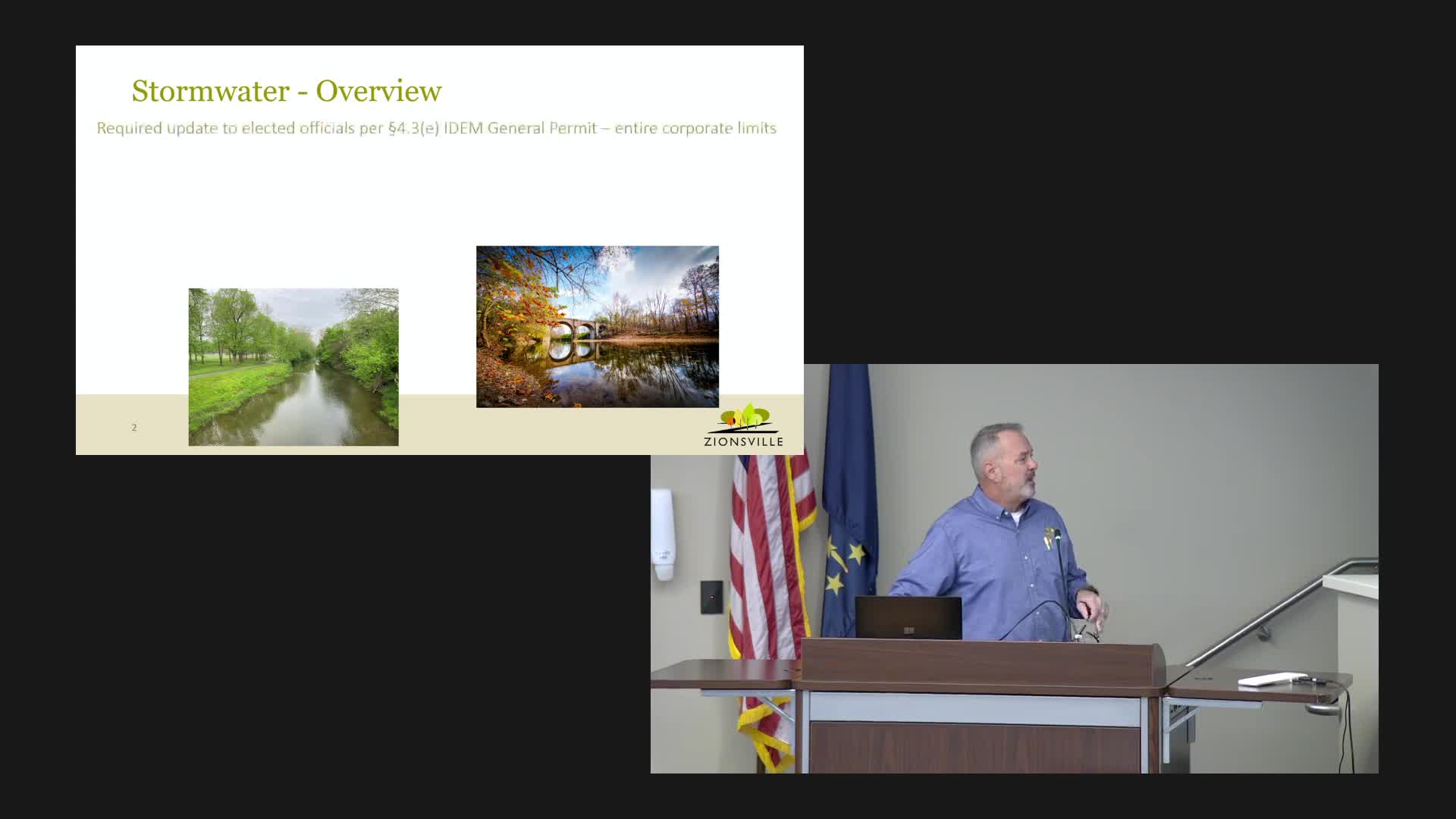
Summary
Town staff told the council the stormwater program requires ongoing MS4 permit compliance and baseline maintenance estimated at about $943,000 per year; staff described three fee models and a process to create a stormwater utility board to recommend any fee.
DPW staff presented a detailed update on the town's stormwater program, noting state and federal permit obligations and an estimated $943,000-per-year baseline cost to maintain current services.
The presentation by DPW staff and stormwater personnel explained that Zionsville operates under an MS4 permit governed by the U.S. Environmental Protection Agency and the Indiana Department of Environmental Management and that the town must provide annual reporting and comply with six minimum control measures. "We are required to give this update at least annually to the elected officials per our permit," staff said during the presentation.
Why it matters: staff said current revenues cover only a small fraction of the town's stormwater expenses. The town has averaged about $35,000 a year in fees and fines over five years, while the projected baseline budget to sustain compliance and routine operations approaches $943,000.
Staff described typical responses municipalities use to close the funding gap: three common stormwater-utility fee structures used in Indiana — a flat monthly fee, a per-acre charge, or an impervious-surface (ERU) fee. "There are three common methods for a stormwater utility in the state of Indiana," staff explained, noting roughly 120 cities, towns and counties use a utility model and that statewide average residential ERU fees are about $6.51 per month. Staff emphasized the number cited was a statewide average, not a Zionsville-specific proposal.
Councilors were given the next steps the administration would take if it wishes to pursue a utility: the mayor would appoint a stormwater utility board that would take testimony, evaluate funding options and recommend a justified fee; the board would be required to hold a public hearing before any fee ordinance was brought to the council. "That board would then take several months to take testimony from staff, considerations, needs, and review things," staff said.
Staff also reviewed operational work that contributes to program cost: inspections of roughly 168 town-owned outfalls, quarterly facility inspections, street-sweeping that removed an estimated 541 tons of material over five years, and infrastructure repairs such as culvert rehabilitation that used in-place lining to avoid road closures.
Council members asked for clarifications about the statewide average fee cited and about how a utility might affect other town budgets. One member pressed whether the $6.51 average was calculated for Zionsville or statewide; staff confirmed it was the statewide figure and that the next steps would be studies and public input before any proposal reached the council.
What happens next: staff said they had completed a consultant study that sketched possible utility scenarios and that formal consideration would require creating a utility board, public hearings, and, if recommended, an ordinance establishing any fee. No ordinance or fee was proposed or adopted at the meeting.