Guam lawmakers press GRTA on aging fleet, missed grants and $9.5M park‑and‑ride project
Get AI-powered insights, summaries, and transcripts
SubscribeSummary
At a Nov. 13 oversight hearing, legislators pressed the Guam Regional Transit Authority about an aging fleet, $52,000 monthly rental costs, gaps in fare handling and an active $9.5 million federal park‑and‑ride grant; GRTA’s interim executive manager outlined procurement plans and a system review to improve service.
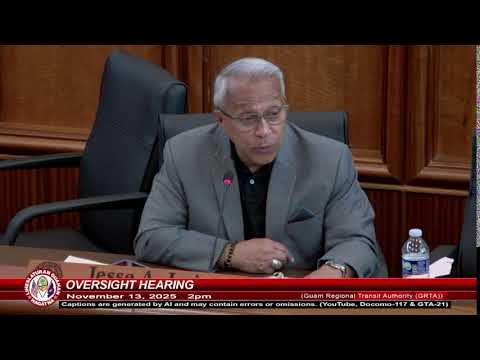
The Guam Legislature’s Committee on Transportation, Tourism, Customs, Utilities, Federal and Foreign Affairs held an oversight hearing on Nov. 13 to examine the Guam Regional Transit Authority’s finances, fleet condition, federal grants and workplace policies. Committee chair Senator Luann opened the hearing at 2:00 p.m. and asked GRTA to explain current operations and a path forward.
Tyrone “Ty,” interim executive manager and acting administrator of the Guam Regional Transit Authority, said the authority operates eight fixed routes plus a paratransit service and is designed to field 14 buses per shift but currently deploys about nine vehicles per shift because an aging fleet has left many buses in repair. "Current rental cost right now is 52,000 a month for the vehicles that we're currently renting," Ty said, citing rental costs that GRTA is trying to eliminate by increasing operability and buying new buses.
Ty outlined a multi‑stage procurement plan: an earlier procurement for 13 buses submitted to the attorney general in February that remains pending; a second procurement for 13 additional buses (about $4.2 million) planned to start soon; and a possible 2026 procurement for roughly 10 more buses, depending on available federal funding. He said warranties accompany bus purchases but that maintenance contracts are procured separately and that a recently awarded maintenance contract is awaiting a GSA purchase order.
On capital grants, Ty said GRTA has encumbered $3,000,000 in federal design funds for a new GRTA administrative and maintenance facility and has received a $9,500,000 federal grant for the Dedito Park‑and‑Ride project to fund construction and rolling stock. "GRT has also received a $9,500,000 federal grant for the Dedito Park And Ride project," he said, adding that the grant covers buses and facility construction but not ongoing operating costs. Ty told the committee GRTA is discussing with the Federal Transit Administration whether to shift the grant from electric buses to conventional diesel buses to save acquisition and charging‑infrastructure costs and reallocate savings to construction and rolling stock.
Lawmakers pressed for transparency and controls. Senator Perez asked about FY2024 audit findings and internal controls for non‑appropriated funds. Ty said local appropriations are about $2,800,000 and that GRTA retains multiple federal grants, but he has been on the job only a few weeks and will deliver the audit findings and corrective measures to the committee. Ty said he has instructed staff not to spend money from non‑appropriated funds until proper procedures are in place. He acknowledged a backlog of fare cash at GRTA offices that must be counted and deposited: "There is a backlog on that now, but we're moving aggressively to pursue that down," he said.
The hearing also focused on governance and leadership continuity. Senators noted GRTA has not had a full board quorum since roughly 2023 after criminal cases involving former officials; Ty said the authority has operated by seeking approvals through the governor when board action was required and that recruitment of board members has been difficult since the prior legal issues. Several senators pushed for a roundtable with the Department of Public Works (DPW) to evaluate whether reorganizing GRTA under DPW or keeping it independent would improve operations. Ty said reorganization is within the legislature’s prerogative but cautioned that reorganization alone may not solve core operability problems.
Other issues covered included service reliability and coverage (Ty estimated roughly 170 rides per day and said paratransit demand often outstrips supply), the high percentage of limited‑term employees (about 31 LTAs of 46 staff) and proposals to classify more positions via DOA lists to improve retention, and bus‑stop infrastructure: GRTA has about 128 stops, of which roughly 97 lack benches or shade. Ty described plans to sketch compact, easement‑friendly stop upgrades.
Riders and legislators described service as deteriorated and urgent. Long‑time rider Evelyn told the committee delays routinely stretch to hours and urged immediate, practical fixes that do not depend on statutory changes. Committee members asked whether declaring a state of emergency would speed procurements; Ty said emergency declarations would not meaningfully bypass procurement statutes for the scale of bus acquisitions and preferred cooperation, targeted procurement strategies (open purchase orders, IDIQ/IDFQ approaches) and administrative diligence.
The committee closed the hearing at 3:50 p.m., asked for the FY2024 audit, grant documentation, updated ridership and fare‑deposit figures, and scheduled follow‑up oversight including a roundtable with DPW and GRTA staff. Written testimony was invited within seven days.