Montgomery County outlines Prerelease Center outcomes, data plan and program expansions
Loading...
Summary
Department of Corrections and Rehabilitation briefed the Public Safety Committee on the 144‑bed Prerelease Center, reporting an 80% program completion rate, 66 residents as of mid‑November, planned IT upgrades and a revalidation of the risk assessment with a contract expected in about six weeks and operational data in 18 months.
Montgomery County—s Department of Corrections and Rehabilitation told the Public Safety Committee on Nov. 17 that its 144‑bed Prerelease Center (PRC) is operating with about 66 residents and an estimated program completion rate of roughly 80 percent, while staff pursue updated data systems and new partnerships to expand reentry supports.
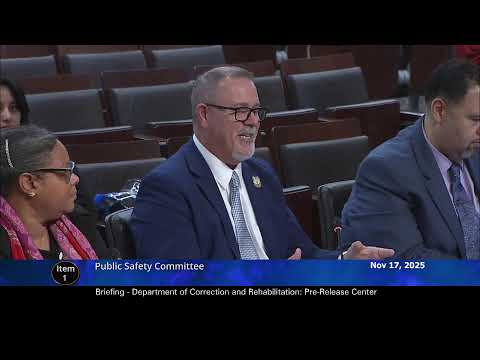
"This is a briefing on the Prerelease Center, which is a 144 bed residential facility," Ms. Farag said in opening remarks summarizing the staff report. Director Ben Stevenson, who led the presentation, described the PRC as an "open campus" reentry program created in the early 1970s to emphasize case management, family engagement and work readiness rather than traditional custodial confinement.
Stevenson told the committee the PRC—s eligibility rules are statutory: residents generally must be within one year of their sentence and must volunteer to participate. "You have to be within 1 year of your sentence," he said. Judges share authority over placement decisions, Stevenson added, and the department commonly recommends people who can be safely managed in the community.
Committee members pressed staff on outcomes and follow‑up tracking. Stevenson said the department runs exit surveys and recently restarted a "Welcome Home" mentoring program; it has also arranged a cooperative 10‑year recidivism study with the governor—s crime prevention unit and expects a memorandum of understanding to be finalized soon. "We have about an 80 percent success rate," Stevenson said when summarizing performance data.
The PRC—s employment and housing figures showed a post‑COVID dip: employment at release dropped from about 74 percent pre‑COVID to about 58 percent now, and staff said while 98 percent of residents leave with a housing plan, those arrangements range from formal leases to informal family housing. Program components highlighted included a three‑month "Sweet Release" bakery job‑training cohort, job fairs to recruit employers, work‑release coordinators that maintain long‑standing employer relationships, and cognitive behavioral therapy integrated with other supports.
Staff described a set of pilot and innovation ideas under consideration: expanding short‑term certification courses, repurposing unused bed space for other treatment models following a pilot and evaluation in January, a Second Chance Canine pilot in partnership with Montgomery County Animal Services, and a music‑therapy volunteer who has incorporated violin instruction into therapy classes. Stevenson said some grant applications (including a federal green‑jobs grant) were not funded and that the department is seeking alternative ways to professionalize horticulture and recycling programs on site.
A priority for the department is modernizing data and risk‑assessment tools. Section Chief for IT and Data Analytics Janet Kwaku described work to move assessments from paper into an electronic system and build dashboards for operational decision‑making. Stevenson said the department is finalizing a contract for a new risk‑assessment tool and expects the contract to be completed within about six weeks; staff estimated roughly 18 months to fully implement and operationalize the data for supervision and assessment decisions.
Stevenson also described statutory and operational limits that affect referrals to the PRC: a backlog in circuit court sentencing and an increase in pretrial detainees have reduced the pool of court‑sentenced residents who meet the one‑year eligibility window. He said the department will consult stakeholders — including the state—s attorney and the public defender—s office — before pursuing any change to statutory eligibility (for example, moving from 12 to 18 months).
Committee members raised concerns about whether additional clinical or crisis‑stabilization services should be colocated at the PRC. Stevenson said using an unused unit for a crisis stabilization model would require substantial staffing (he estimated roughly 24 full‑time positions for a small unit) and recommended piloting and evaluating options before committing to a new use.
On facility condition, Stevenson said the building is more than 50 years old and that Department of General Services reviews have focused on window replacement and other infrastructure work rather than a large new capital project.
The committee asked staff for follow‑up information on the risk‑assessment contract timeline, pilot designs for underused bed space, and output from the ongoing recidivism study once the MOU and data work are underway. The session ended after staff agreed to provide additional materials and interim updates as the IT and assessment work progresses.
The Public Safety Committee adjourned after the briefing; staff said they will return with more detailed timelines and pilot proposals as available.