Get Full Government Meeting Transcripts, Videos, & Alerts Forever!
Get email alerts on the Land Use UDO topic
No spam. Unsubscribe anytime.
Clemmons council hears legal hurdles to UDO overhaul after state downzoning rule change
Summary
Village Attorney Bernie Bischoff told the Clemmons Council that a December 2024 state law requiring property-owner consent for downzoning has complicated adoption of the village's new Unified Development Ordinance; councilmembers debated options and tentatively eyed public hearings in late winter or spring.
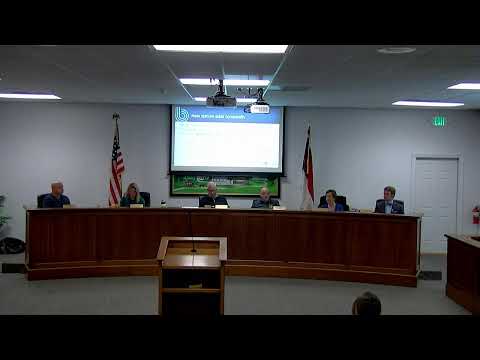
Village Attorney Bernie Bischoff told the Village of Clemmons Council on Nov. 10 that a December 2024 change to North Carolina's zoning statutes has made adoption of the village's new Unified Development Ordinance (UDO) more complicated.
Bischoff said the UDO is normally adopted in two parts ' the text and the zoning map ' and described the typical process: the text is sent to the planning board for recommendation, notice is published, a public hearing is held and the council adopts the ordinance. "The map will have to change because the zoning districts aren't changing," he said, and added that doing both text and map together is often impractical because of mailing and notice requirements.
He told the council that the statute adopted in December 2024 requires written permission from property owners before a local government can impose zoning changes that reduce allowable density or remove permitted uses. "To the extent that the UDO decreases allowable densities or removes permitted uses in the modified zoning districts, that can't be done unless the property owner signs a paper that says I'm okay with that," Bischoff said.
Bischoff outlined options for the council: delay action and wait for possible legislative fixes; adopt the text now and the map later; adopt only sections that do not trigger the downzoning restriction; or adopt both and risk litigation. He warned that losing a land-use lawsuit could require the village to pay the plaintiff's legal fees as well as its own.
Councilmembers questioned timing and next steps. Staff and consultants said another public open house and hearings with required notifications are likely, with a tentative window of late February to March for hearings if no significant complications arise. "If there's a number of issues Clarion still needs to address, it may slow it down a little longer than that," a staff representative said.
The council debated the legal characterization of downzoning. One member argued that materially reducing a property's value creates an obligation to compensate the owner; another countered that the term "taking" has a specific legal meaning and that traditional zoning changes have not been treated as takings. "When the village council changes the zoning of a property from a high intense use to a lower intensity use, that is not a taking," Bischoff said, reflecting the longstanding legal view he described.
Members repeatedly emphasized the council's goal of aligning zoning with the village's comprehensive plan and protecting mixed-use corridors such as Lewisville-Clemmons Road. Several councilmembers said the current UDO is outdated and that public engagement should continue as staff and consultants refine the draft.
The council did not take final action on the UDO at the meeting. Staff advised more public outreach and technical work before the council votes on code or map changes. The next public steps are expected to include an open house, planning-board review and required mail notice to affected property owners.