Get Full Government Meeting Transcripts, Videos, & Alerts Forever!
Get email alerts on the Land Use Annexation topic
No spam. Unsubscribe anytime.
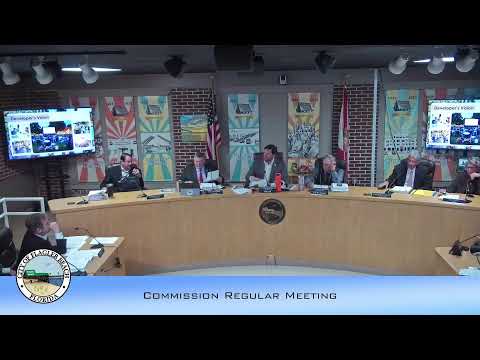
Flagler Beach moves forward with Summertown annexation after heated public debate over Beulah Creek protections
Summary
On first reading the Flagler Beach commission voted to transmit the Summertown annexation package to state review while insisting on workshops and continued negotiations after residents pressed for stronger creek buffers, limits on development in flood‑prone AE zones and guarantees on wastewater/well capacity.
Flagler Beach voted on first reading Thursday to move forward with a package of annexation measures for the Summertown development, sending the future‑land‑use amendment to state review while scheduling workshops to seek additional commitments from the developer and county. The first‑reading approvals — annexation, comprehensive plan amendment and zoning — were framed by hours of public comment and a county presentation focused on the Beulah Creek watershed.
The commission’s vote keeps the city "at the table," commissioners said, allowing further negotiation of safeguards before a final decision. A motion to approve annexation ordinance 2025‑22 on first reading included a condition that the city hold a workshop between readings; the motion passed on a 4‑1 roll call. The same pattern repeated for the comprehensive plan amendment (transmittal to the Department of Economic Opportunity) and the zoning ordinance on first reading.
Why it matters: the area under discussion contains part of the Beulah Creek/Bulow watershed and a mapped special flood hazard area (Zone AE). County staff told the commission they had not previously pursued acquisition of the most flood‑sensitive parcels because there was no willing seller; after developer Ken Belshi signaled willingness to discuss land purchase, county staff said they would initiate the formal acquisition forms and work with the St. Johns River Water Management District, North Florida Land Trust and Florida Forever to evaluate possibilities.
County concerns and developer commitments: Sarah Spector, assistant county attorney, and Adam Mingle, the county’s growth‑management director, urged clearer language in the master plan development agreement (MPDA) and the FLUM package. They asked that buffer language specify distance from the property line (not just riverbank), that the conversion table clearly cap total intensity (so conversions cannot be used to exceed agreed caps), and that MPDA language reference amended standards of the water management district. Mingle also reiterated that the special flood hazard area in the Summertown parcel is predominantly Zone AE and said the county will provide land‑acquisition forms as soon as the seller indicates willingness to sell.
Residents’ concerns: During public comment roughly four dozen residents, business owners and conservation advocates questioned whether a 75‑foot buffer is sufficient, urged the city to require the developer to exclude AE floodplain from development, and asked for clearer fiscal and infrastructure analyses. One resident asked for a workshop before the second reading to let state and DOT reviews be completed and publicly discussed; another urged the city not to ‘‘give up negotiating leverage’’ by transmitting the FLUM without firm preservation commitments.
City response and process: Commissioners repeatedly emphasized that first reading is not a final approval and allows the city to continue negotiating. "If you don't annex it, you're out of the conversation," said a commissioner during debate, arguing the alternative is ceding control to the county or another municipality. Several commissioners voiced willingness to proceed with first readings while negotiating specific protections — for example, strengthening tree‑preservation language, clarifying the conversion cap, and seeking county follow‑through on land purchase.
Next steps: The commission scheduled a workshop to take place before the second reading to review agency comments and to continue negotiating language on buffers, floodplain protections and infrastructure commitments (water/wastewater/wells). The comprehensive plan amendment will be transmitted to the state Department of Economic Opportunity for agency review as part of the adopted procedural motion.