
Appraiser says Camarillo greenhouse worth $99 million; buyer paid $93 million in cash for hard assets, board hears
Get AI-powered insights, summaries, and transcripts
Subscribe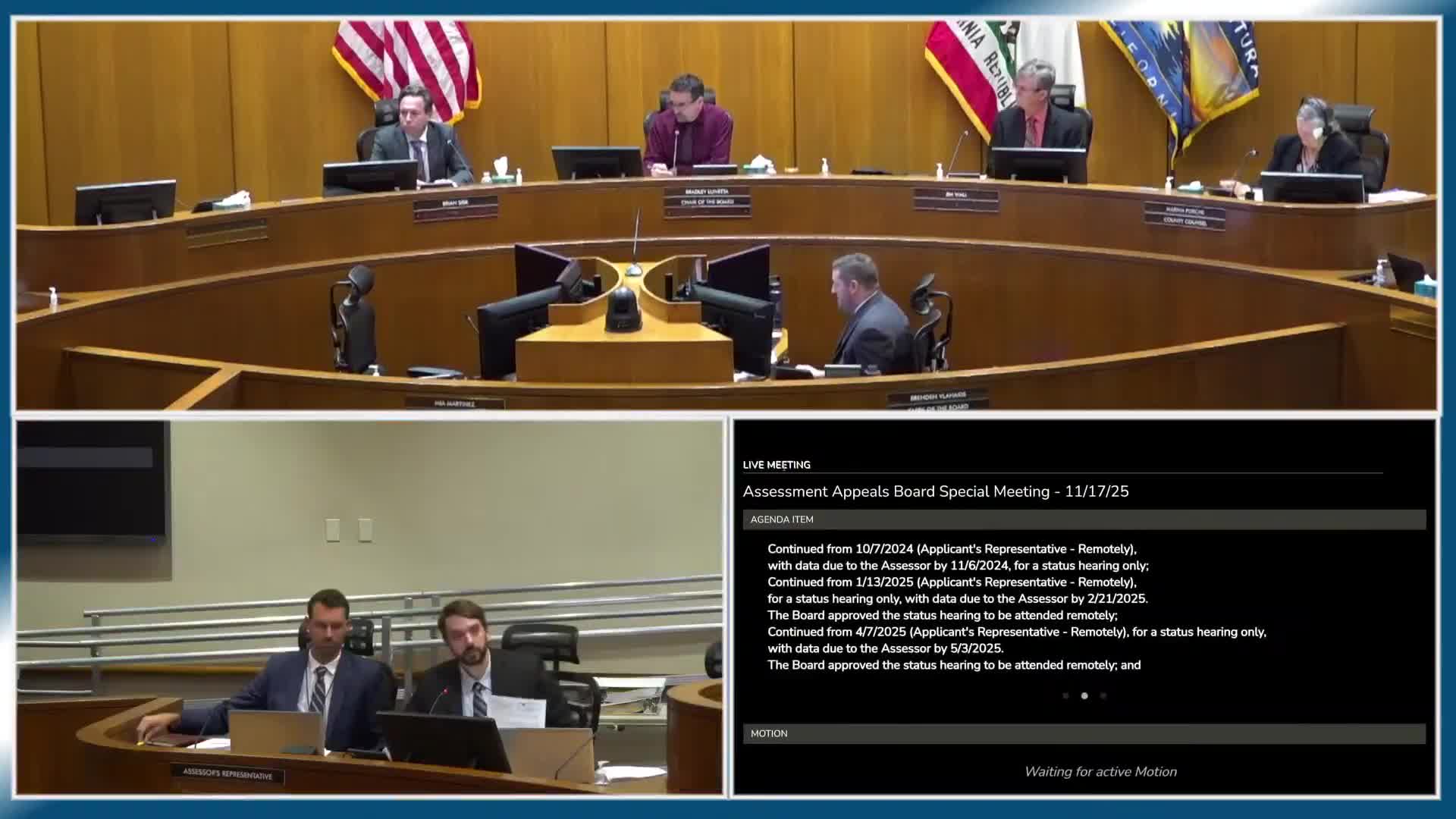
Summary
At a Nov. 17 Ventura County Assessment Appeals Board hearing, the buyer and seller testified about the Sept. 15, 2021 transfer of the 645 Laguna Road greenhouse. Applicant appraiser Ben Slaughter concluded a $99 million value; Glasshouse CFO and witnesses described conversion plans, an $87.3M retrofit estimate and separate share‑based payments to an option holder. The board continued the hearing to Dec. 15 with a data deadline.
The Ventura County Assessment Appeals Board heard testimony on Nov. 17 about the base‑year valuation for a 160‑acre greenhouse complex at 645 Laguna Road in Camarillo. The property transferred on Sept. 15, 2021, and county records show a $93,000,000 cash grant deed for the hard assets. The applicant’s appraiser, Ben Slaughter, testified he reconciled sales‑comparison and cost approaches and concluded a fee‑simple real‑property value of $99,000,000 as of the Sept. 15, 2021 date of value.
Slaughter, an accredited rural appraiser, told the board he used a sales‑comparison analysis and a cost approach as his primary valuation tools. He said the 2021 sale of the subject was “a lot more meaningful” than earlier transactions because the buyer and seller negotiated the final price rather than relying on a preset option schedule. He testified that, after statistical size adjustments and cross‑checks, the sales‑comparison indicator equated to about $94.4 million and the cost approach produced a higher indicator; reconciling the two, he reached $99,000,000.
Glasshouse Brands’ chief financial officer, Mark Vendetti, testified that Glasshouse paid $93,000,000 in cash for the land, buildings, fixtures and machinery and separately acquired the option held by industry broker Casey Howling through share transfers (no cash). Vendetti said the option and an earn‑out were settled in Glasshouse stock, and that the share‑based elements were distinct and not part of the $93,000,000 cash consideration for the hard assets.
Vendor representative Gavin Halladay, who negotiated on behalf of seller Equilibrium/CEFF, described the property's condition on the date of transfer as mixed: phases 1, 3 and 4 were “almost fully depreciated,” while phases 5 and 6 were newer and in better condition. Halladay said CEFF had previously invested about $85,000,000 in the site and estimated in 2021 that bringing older greenhouses up to vegetable‑production standard would have cost about $20–$25 million (he later said that would be higher in current dollars).
Vendetti and other witnesses described Glasshouse’s conversion plan to cannabis production as a multi‑phase project with an early‑date estimate of roughly $87,316,763 to retrofit the site for cannabis as of Sept. 17, 2021 (applicant exhibit 2). Vendetti read a technical report by the site engineering director into the record explaining that converting tomato/cucumber high‑wire greenhouse technology to cannabis requires extensive changes: new irrigation and distribution systems, new ground and vapor membranes, blackout cloth, new drying and processing rooms with precise climate control, and perimeter security and testing workflows.
Slaughter told the board he considered Measure O (Ventura County’s cannabis cultivation framework), but concluded that, on Sept. 15, 2021, a cannabis conversion was legally permissible but speculative and not yet a financially proven highest‑and‑best use for a facility of this scale without the substantial retrofit investment he and the engineering witnesses described. He said he drew lessons from earlier Canadian market experience, in which early legalization produced speculative over‑building and later price declines.
On technical points, Slaughter described using a regression‑based size adjustment for per‑square‑foot comparisons, and a market‑extraction method to isolate total depreciation and obsolescence from comparable transactions. After measuring replacement cost, physical depreciation (age‑life), and the residual obsolescence shown by the market extractions, he applied a 30% obsolescence factor in his cost approach and judged that combination appropriate to reconcile to $99,000,000.
Assessor’s counsel and board members probed multiple aspects of the evidence: the timing and completeness of exhibits, whether the assessor had received key retrofit estimates earlier, the handling of non‑cash share consideration and earn‑outs, and whether alternative comparables (including earlier cannabis‑speculative sales in the Salinas area) should be included. Counsel also questioned some internal report statements (for example, a mis‑statement about a Williamson Act enrollment) and the appraiser’s prior work disclosures; Slaughter acknowledged an editing error and offered to correct the report language on prior engagements.
The hearing record contains competing factual threads that the board flagged for further work: (1) the buyer reported $93,000,000 cash for hard assets on the grant deed and settlement statement; (2) Glasshouse separately accepted stock‑based payments to acquire an option from Casey Howling and an earn‑out that was to be paid in shares; (3) applicant witnesses presented an $87.3M conversion‑cost estimate prepared near the date of transfer and later higher realized costs; and (4) the appraiser concluded a $99,000,000 market value after reconciling sales and cost approaches and accounting for obsolescence.
Before the assessor presented its case, the board ruled that a lender‑prepared appraisal tendered by the assessor could not be admitted because its author declined to appear for cross‑examination and the board’s posted guidance (and longstanding local practice) requires a release and availability of the author for testimony when third‑party appraisals are offered. The ruling led the assessor to request a continuance to revise its presentation.
The board granted a continuance. It set the next hearing date for Dec. 15, 2025, at 8:30 a.m. and ordered any additional data from the applicant to be provided to the assessor by Dec. 1, 2025 (data proviso). The applicant said it would inquire about whether a GAAP allocation report exists and would provide documents in good faith; the assessor reserved its right to request additional time if large new materials arrive.
What’s next: The Assessment Appeals Board will reconvene on Dec. 15, 2025. The assessor will present its case then; the applicant has reserved rebuttal time. Any documents the applicant submits by the Dec. 1 deadline will be part of the assessor’s preparatory materials and may shape the issues the board will decide at the continued hearing.
Quotes from the hearing (abridged and attributed): "We received $93,000,000 in cash for the hard assets" — Mark Vendetti, chief financial officer, Glasshouse Brands Inc. "My concluded value is $99,000,000" — Ben Slaughter, appraiser. "Conversion to cannabis would require substantial rework — new irrigation, blackout cloth, dry rooms and precise climate controls" — read into record by Mark Vendetti from the report of site engineer Vance Pronson.
Next steps: the board will take evidence and argument when it reconvenes; the account of conversion costs, the sales‑comparison adjustments, and the treatment of non‑cash consideration remain central disputed facts the board will weigh before issuing its decision.