Get Full Government Meeting Transcripts, Videos, & Alerts Forever!
Get email alerts on the Budget topic
No spam. Unsubscribe anytime.
Council reviews FY26 amendment to allocate unallocated funds and adjust development services budget
Summary
City staff proposed an amendment to the FY26 budget to allocate unallocated balances to prior commitments (including a $3M A2 corridor interlocal and a $2,028,000 fire ladder truck payment) and to increase funding for third‑party development services to $830,000, funded by revised revenue estimates, vacancy savings and EDC support.
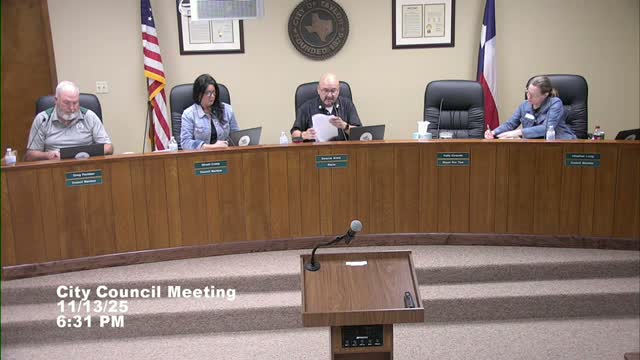
City staff presented a two-part budget amendment introduced as Ordinance 2025-36 that would allocate existing unallocated fund balances to previously made commitments and adjust the general fund development‑services budget.
Mr. Powers described 'proposal A' as staff recommendations for prioritized allocation of unspent balances, including the city's $3,000,000 interlocal pledge for the A2 corridor (payment rescheduled to February 2028), a $2,028,000 payment for an on‑order fire ladder truck and a $200,000 local share for County Road 366 improvements. He said these are commitments the city previously entered into and staff recommends earmarking funds now rather than issuing new debt.
On 'proposal B' Mr. Powers explained the request to create an $830,000 budget for third‑party development services. He said staff identified additional revenue and vacancy savings, and the Economic Development Corporation agreed to contribute $60,000 toward development-related third‑party costs. "The recommendation overall tonight is that we... prioritize existing commitments that the city of Taylor has already entered into," Powers told the council.
Several council members sought historical context on the interlocal agreements and asked for more archival information before final decisions. Staff agreed to provide background on the ILAs and payment timing. The ordinance was introduced for adoption as an amendment to the fiscal year budget; staff said the item will return for final reading and formal adoption.
Next steps: staff will provide historical documentation on the ILAs and specifics of the prior commitments, and the ordinance will proceed through the city's reading schedule.