
Commissioners deny Derna/T‑Mobile permit and reject categorical CEQA exemption amid wildfire and road‑access concerns
Get AI-powered insights, summaries, and transcripts
Subscribe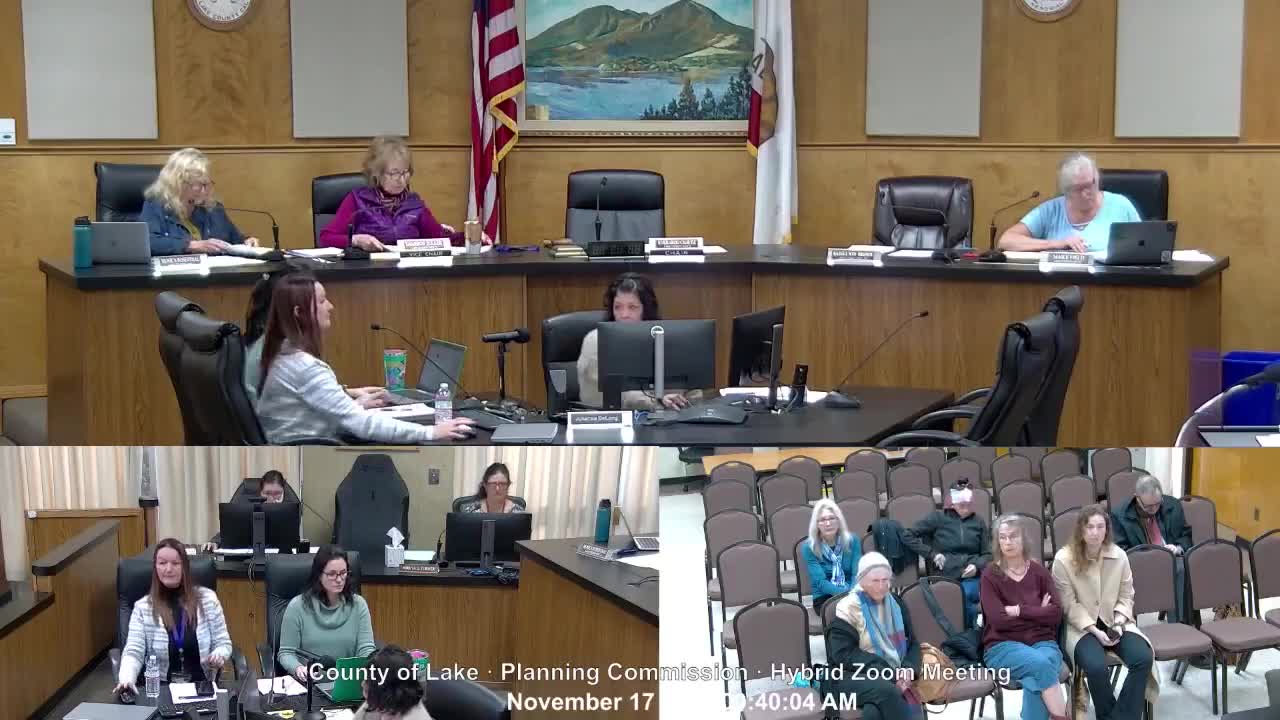
Summary
Lake County planners denied the Derna Group’s request to use a dormant 55‑foot tower on Water Trough Road for telecommunications, voting both to withhold a categorical CEQA exemption and to deny Major Use Permit PL‑25‑15 after residents and commissioners raised fire‑safety and private‑road access problems.
The Lake County Planning Commission voted to deny both a categorical CEQA exemption and a Major Use Permit requested by the Derna Group to refurbish and colocate equipment on an existing 55‑foot tower at 1135 Water Trough Road, Clear Lake Oaks (PL‑25‑15).
Max Stockton, associate planner, told the commission the site is an existing facility and staff recommended adoption of a categorical exemption and approval of the permit. Stockton noted a protected bird nest registered on site that American Tower monitors and said staff had reviewed applicable zoning code articles and categorical exemption guidance in CEQA.
Members of the public, including representatives of the Double Eagle Ranch Property Owners Association, challenged staff's recommended exemption. Angela Amaral and other residents said the project site has been dormant for decades, that Water Trough Road is a narrow private road with a 12‑ton limit and limited egress, and that Cal Fire and other agency comments flagged deficiencies including the need for defensible space and a water tank for fire suppression. Anne Riggs (licensed architect) and other commenters argued the proposed reuse adds new fuel and ignition sources and therefore should undergo a full CEQA initial study rather than be treated as a minor alteration to an existing use.
County Counsel and staff explained legal standards for CEQA exemptions and statutory exceptions (citing Cal. Code Regs. §15300.2 and relevant case law); counsel described the two‑part "Berkeley" framework used by courts to determine whether an "unusual circumstance" exists. Counsel also warned the commission about federal telecommunications "shot‑clock" deadlines that constrain local processing of wireless siting applications, noting a shot‑clock expiration later in the week.
After public comment and deliberation—during which several commissioners said they could not make required findings because of unresolved road and fire‑safety issues—a commissioner moved to find the categorical exemption inapplicable and to deny the permit. The commission voted in favor of denying the exemption and then voted to deny Major Use Permit PL‑25‑15. Commissioners recorded the rationale on the record: concern about public safety, private‑road adequacy and the need for a fuller environmental review in light of changed site conditions.
Staff advised the applicant and any interested party that the county’s zoning ordinance provides a seven‑calendar‑day appeal period to the Board of Supervisors; the commission’s denial does not prevent the applicant from resubmitting with further mitigation or information.
The commission directed staff to record the findings and to include the public comments in the administrative record for any subsequent review or appeal.