
Carpinteria staff propose new assessment rates to cover berm and landscaping maintenance
Get AI-powered insights, summaries, and transcripts
Subscribe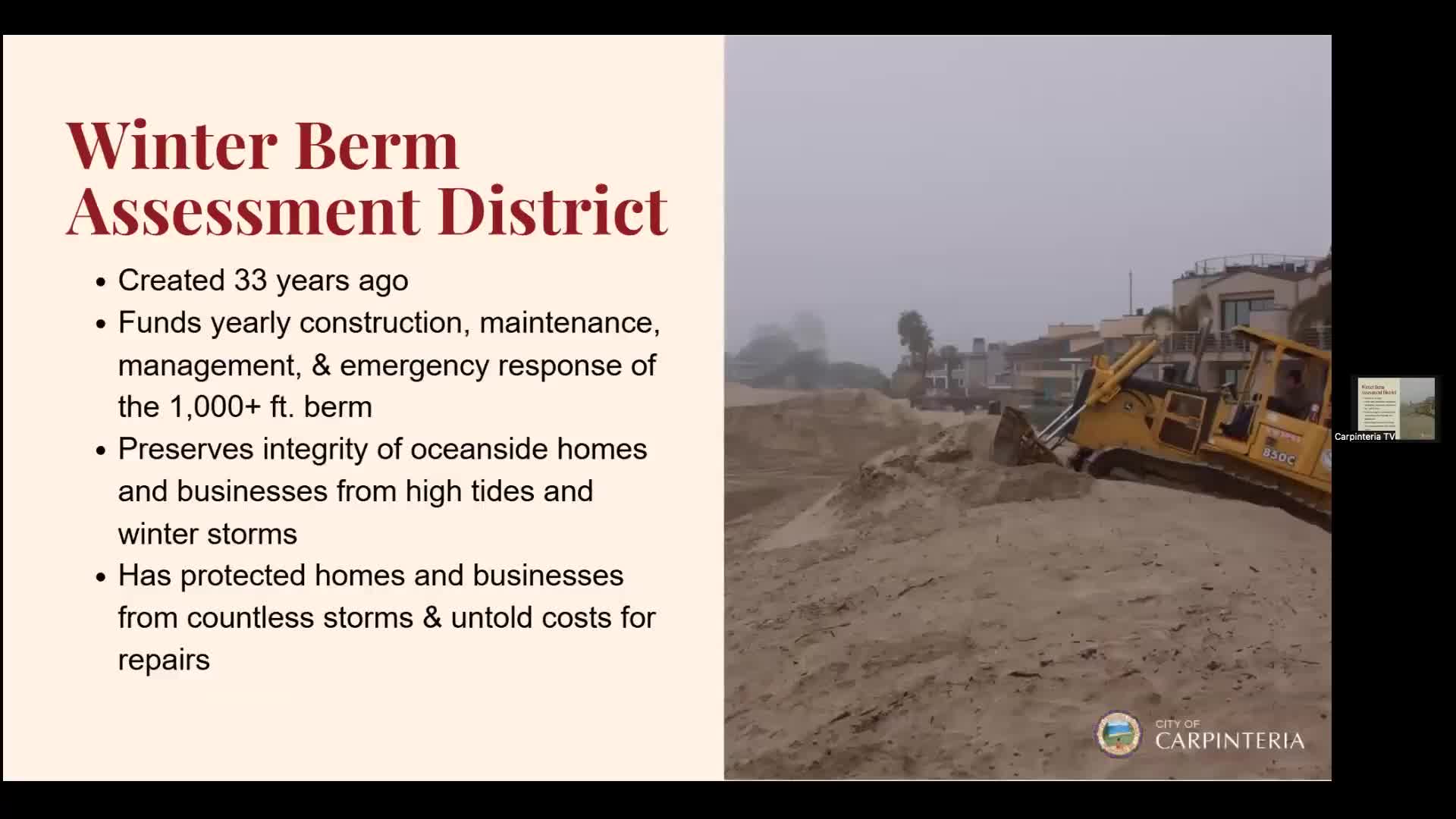
Summary
City staff proposed updating two assessment districts — a winter berm district and a citywide landscaping/maintenance district — to cover rising maintenance costs, citing engineering analysis and the Proposition 218 ballot process; staff gave proposed per-unit and per-parcel rates and answered public questions via Zoom.
City staff presented proposals to update two assessment districts that would shift the cost of coastal berm maintenance and citywide landscaping from the general fund to beneficiaries.The presentation, given in Spanish and streamed on Zoom, laid out staff estimates of current deficits, proposed assessment amounts and the procedural steps required under Proposition 218 for voter approval.
The winter-berm district currently raises roughly $20,000 annually while staff said berm maintenance runs about $98,720, creating an annual subsidy from the general fund of approximately $73,500. City staff told listeners the city’s engineering report will apportion benefits by factors such as distance and elevation from the beach and reported an example: the current equivalent-benefit charge would be about $193.80 (about $16 per month) and the proposed updated assessment per benefit-equivalent unit would be about $284.48 (about $23.70–$24 per month). Speaker 1 framed the update as intended to prevent the general fund from repeatedly subsidizing berm repairs.
For the citywide landscaping/maintenance district, staff said collections are currently about $200,000 but engineering analysis shows roughly $1.5 million would be required to address deferred maintenance and restore the service level. Staff estimated a related fiscal-year shortfall near $1,000,000 and proposed a 2025 assessment of $165 per parcel per year to close the funding gap and sustain tree care, median landscaping, graffiti removal and sidewalk-related maintenance.
Staff explained Proposition 218 steps required to create or change assessment districts: the city must produce an engineering report that calculates benefit apportionment, mail ballots to property owners, and tabulate weighted ballots under the assessment-vote rules. Staff emphasized that ballots go to property owners and that votes are counted by weighted property ballots rather than one-person/one-vote.
A resident participating by Zoom raised concerns about deferred maintenance tied to aging trees and asked why residents should pay when earlier plantings may have been unsuitable for sidewalks. Speaker 2 said engineering reports and the Proposition 218 process address benefit apportionment and deferred-maintenance calculations, pointed listeners to the full engineering report and the city website for line-item details, and offered an assessment-district email (assessmentdistrict@carpinteria.gov) and five council-led outreach presentations for follow-up.
The presentation closed with a reminder to review the posted materials and to vote on the proposed assessment districts when ballots are mailed. "Por favor, no se olviden de votar," Speaker 2 said in closing.