Board amends OE‑4 after debate over SRO data, equity and reporting
Loading...
Summary
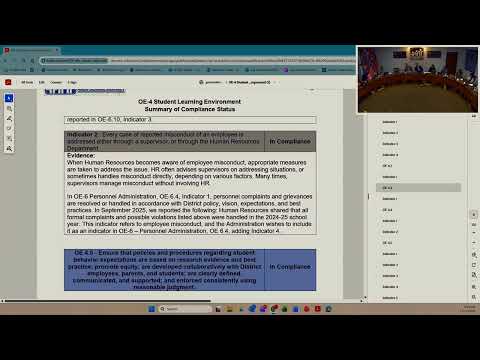
Trustees approved the OE‑4 monitoring report as amended after a prolonged discussion about SRO contacts and racial and special‑education disparities; the board changed OE‑4.4 to 'in compliance with exception' and asked administration for additional intersectional data.
The Eau Claire Area School Board approved its OE‑4 (Student Learning Environment) monitoring report after amending the compliance finding for OE‑4.4, following extended discussion about school resource officer (SRO) contacts and disparities.
Superintendent Johnson introduced OE‑4 and described evidence of compliance across multiple indicators, including HR verification completion and district training. He also told the board that, per Act 12 and DPI reporting rules, the district had submitted arrest and citation data for North and Memorial high schools and had met with police to clarify reporting requirements.
Multiple trustees raised concerns during the discussion that followed. Commissioner Dement moved to amend OE‑4.3 (environments free from bullying, discrimination and bias) to read 'in compliance with exception' on the basis of data showing disproportionate SRO contacts for students with IEPs and students of color; that amendment failed after discussion and a vote. The board then moved to amend OE‑4.4 (disallowing behavior by employees, volunteers or visitors that hinders student well‑being) to 'in compliance with exception' to reflect gaps in the indicators and evidence presented (particularly regarding volunteers, visitors and SRO-related activity); that amendment passed.
Board members pressed for more detailed, intersectional data (cross-tabulating race, special education status and gender) so that the district can identify groups at greatest risk. Commissioner Beka and others asked the administration to present intersectional SRO and discipline data mid‑year rather than waiting a full year; Superintendent Johnson agreed to provide a mid‑year update.
Several trustees urged the district to study alternative responses to student behavior that rely less on law enforcement and more on restorative‑justice models, social workers and school‑based mental health supports. Superintendent Johnson said the district would continue to consult peer districts — citing research and conversations with La Crosse school leaders — to weigh models for SRO staffing, communications, and community input.
After the amendment to OE‑4.4 passed and OE‑4 was approved as amended, Superintendent Johnson committed to share mid‑year intersectional data with the board and to continue community and staff engagement around SRO policy options. The board recorded the approval by voice vote and adjourned the meeting.