Get Full Government Meeting Transcripts, Videos, & Alerts Forever!
Get email alerts on the Housing Zoning topic
No spam. Unsubscribe anytime.
Committee debates limits, transparency for RN/RL neighborhood zoning in housing bills
Summary
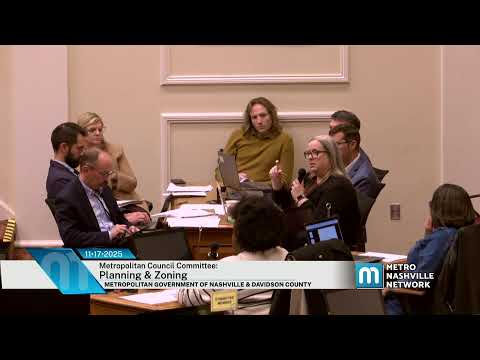
Planning staff and council members debated amendments to BL20251005 and related bills that would cap RN/RL application on block faces, require unit declarations, mandate extra community meetings, and add infrastructure reports; no votes were taken today.
A Nashville planning committee spent its meeting reviewing proposed amendments to housing and infrastructure bills, focusing on restrictions and transparency measures tied to new neighborhood-scale zoning categories labeled RN and RL. The discussion covered four main amendments — a proposed 30% cap on RN/RL on a block face; a requirement that applicants declare a maximum number of units at application; a mandate for two community meetings before public hearing; and a required infrastructure and fiscal-impact report — but the committee took no votes and deferred action to a later meeting.
Why it matters: The amendments aim to balance neighborhood concerns about rapid density changes with the city’s goal of adding housing. Committee members and planning staff debated legal, procedural, and practical effects, including whether the zoning code is the right place to prescribe where zoning districts apply, how to make any numeric limit enforceable, and whether added process would be unevenly applied to only two new districts.
Planning staff said the first amendment, which would ‘‘limit RN and RL to no more than 30% of a block face on a local street,’’ raises multiple issues: the code does not currently prescribe where districts should be applied and the draft’s ‘‘30%’’ metric is undefined (it could mean acreage, number of units, or linear feet of frontage). Planning staff advised that ‘‘the zoning code establishes zoning districts but does not say where zoning districts should be applied,’’ and that where districts go is properly a policy decision rather than a code prescription.
Sponsor Council member Allen said the intent was ‘‘to be responsive to what we’re hearing from people’’ who fear a whole block could be rezoned and transformed; Allen described wanting a way to allow limited neighborhood-scaled multifamily without enabling wholesale replacement of single-family blocks. Council member Parker urged reliance on district council members and, where certainty is essential, the use of specific plans (SPs) that can lock in site-level commitments.
On the proposal to require an applicant to declare a maximum number of units at application, planning staff flagged enforcement and permanence problems: it is unclear how such a declaration would be recorded or whether it could legally bind future changes once a zoning approval occurs. Council member Johnston described the amendment’s intent as ‘‘to take away some of the ambiguity around it for the neighbors’’ so communities know what to expect during rezoning outreach.
Planning also noted Amendment 3’s requirement of two community meetings for RN/RL applications would change the rezoning process for only those two districts and would be ‘‘greater than the requirement for rezoning to higher-intensity multifamily, commercial, or industrial districts.’’ On Amendment 4, which would demand an infrastructure and fiscal-impact report for RN/RL amendments, planning said many infrastructure evaluations already occur (school impact, trip generation, water and sewer capacity) and the new requirement may duplicate existing reviews, though council member Duffel said the intent is to ensure ‘‘the most recent’’ master plans are used as the baseline.
A related discussion touched on BL20251006, where planning staff described a separate proposed limit that would cap duplexes to 25% of a block face on local streets; staff warned this could remove existing two-family rights for parcels that currently enjoy them, and noted historical 25% caps tied to certain subdivision trade-offs (lot size versus clustering) often no longer apply because lot sizes changed after 1984.
The meeting was discussion-only; the committee did not vote on any of the housing or infrastructure bills tonight. Planning staff said they would note committee comments and the items will return for fuller consideration and a vote at the next committee meeting.