Get Full Government Meeting Transcripts, Videos, & Alerts Forever!
Get email alerts on the Opioid Response topic
No spam. Unsubscribe anytime.
Glynn County hears opioid strategic‑plan briefing; presenters seek additional year‑two grant funding to expand naloxone distribution and prevention
Summary
At a special Glynn County commissioners meeting Tuesday, Georgia Southern researchers and county public‑safety staff outlined a five‑phase opioid strategic plan and asked the board to support additional year‑two grant funding to expand naloxone (Narcan) leave‑behind kits, a grant‑funded coordinator role and prevention outreach.
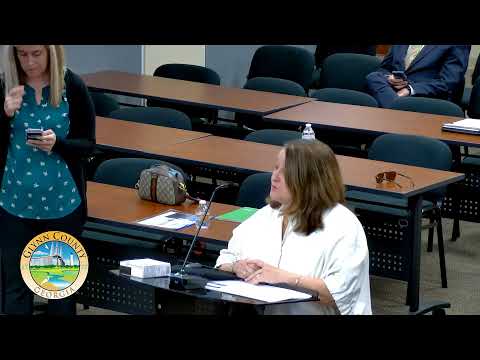
At a special meeting Tuesday, Nov. 18, the Glynn County Board of Commissioners heard a presentation from county public‑safety staff and researchers from Georgia Southern University’s Institute for Health Informatics and Analytics (IHLA) on a strategic plan to reduce opioid use disorder and overdoses in the county.
Lisa Johnson, Glynn County’s public‑safety grants manager, said the work was funded in year one through a COSIP grant managed by the Criminal Justice Coordinating Council of Georgia and that the county contracted with IHLA following a competitive RFP. Johnson asked the commission to support an extension into year two to expand naloxone distribution, add technical assistance, and create a grant‑funded opioid response coordinator to help with data collection, analytics and outreach.
Dr. Jessica Swinn, an epidemiologist and director of IHLA, presented the project’s five phases — situational analysis, stakeholder engagement, development of a planning framework, an action toolkit with an implementation roadmap, and finalization with an executive summary. "Prevention, harm reduction, treatment, and recovery," Swinn said, listing the continuum of care the plan targets.
IHLA’s analysis, Swinn said, showed Glynn County’s fatal overdose rates increased beginning in 2014 and peaked in 2022, with emergency‑department and inpatient visits peaking in 2021. She said counts were highest among middle‑aged adults and noted a national shift in the illicit supply toward fentanyl‑laced substances. Swinn urged the county to focus on crisis response teams (engaging people within 24–48 hours after an overdose), a centralized opioid resource repository, communitywide prevention and education, and stronger handoffs across treatment and recovery services.
County staff and Chief Travis Johnson of Glynn County Fire Rescue described harm‑reduction steps already under way. Johnson said the county has distributed 25 individual naloxone kits and another 12 at a separate distribution; in addition, about 80 kits are available for pickup at fire stations (roughly 10 per station). Demonstrating a kit, Chief Johnson said the packages include two doses of naloxone and an informational flyer. He explained naloxone (Narcan) "binds to opioid receptors" and can reverse an overdose when administered promptly.
On funding, presenters said they planned to pursue the Georgia Opioid State Abatement Trust and other state and federal avenues; they said a strategic plan and roadmap would strengthen future grant applications. During the meeting two close but inconsistent year‑two figures appear in the transcript when staff and commissioners discussed the budget; presenters characterized the year‑two ask as in the low hundreds of thousands of dollars (see clarifying details for the transcript figures and the meeting Q&A). Presenters also said the state opportunity to apply for abatement funds should open in May 2026.
Commissioners asked about demographic patterns in the data, outreach and education strategies, geographic concentrations of overdoses and the county’s approach to sustainability. Dr. Swinn and staff urged asset mapping with local partners — schools, the Boys & Girls Club of Southeast Georgia, the regional community service board and hospital system — and recommended neighborhood‑level presentations to raise awareness of kits and services. Chief Johnson identified a cluster of overdoses near the I‑95 and Highway 341 interchange but said overdoses occurred throughout the county.
The commission received a commitment from presenters to finalize an action toolkit, prepare a public presentation of the plan, and continue pursuing grant funding. The chair then asked for a motion to adjourn; a commissioner moved and another seconded. The transcript records the motion and second but no roll‑call vote.
Next steps described at the meeting include completing the IHLA final report and executive summary, conducting an assets inventory to inform prevention outreach, continuing kit distribution across fire stations and emergency units, and seeking state and federal grant awards to support a coordinator position and expanded preventive services.