
Sandpoint committee favors city‑operations benchmark and student help for greenhouse gas inventory
Get AI-powered insights, summaries, and transcripts
Subscribe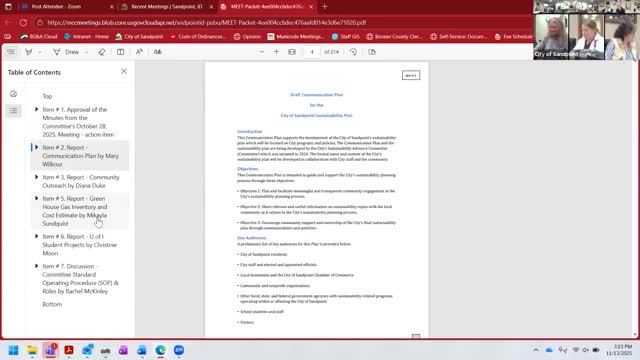
Summary
Members recommended starting a greenhouse gas inventory limited to municipal operations to create a benchmark, and agreed student projects (undergraduate or graduate) could perform much of the initial work rather than costly consultants.
The Sandpoint Sustainability Committee on Nov. 13 debated the scope and cost of a greenhouse gas inventory and gravitated toward a phased approach that starts with municipal operations and uses university students for initial data collection and benchmarking.
Committee members said commissioning a commercial consultant for a full community‑scale inventory would be expensive. One member noted a graduate student or a class project could complete much of the initial work and provide a practical benchmark for the city to measure future progress.
Members discussed the tradeoffs between a tightly scoped municipal inventory (city facilities, vehicle fuel use, government‑purchased electricity and waste streams) and a community‑wide inventory that would also include resident electricity, transportation and business emissions. The committee’s staff liaison said starting small (government operations only) would reduce data requirements and make the project more manageable as a student‑led effort.
Technical methodology was raised: the committee stressed using standard, globally recognized inventory protocols and a consistent method to ensure the data are useful for planning. Staff and members agreed that third‑party verification is optional for an initial benchmark and can be pursued later if needed.
Next steps: committee members will collect available templates and spreadsheet tools a local sustainability scientist provided and will ask the University of Idaho contact which inventory components students could undertake as coursework or independent projects.