Get Full Government Meeting Transcripts, Videos, & Alerts Forever!
Get email alerts on the Workforce topic
No spam. Unsubscribe anytime.
Saint Charles workforce office reports 'phenomenal' year, emphasizes rapid-response services for layoffs
Summary
Thomas Scott told the Parish Council the tri-parish workforce office met or exceeded statewide performance measures despite federal cuts, highlighted local unemployment at 3.7%, and described rapid-response services (on-site orientations, a bus computer lab and one-on-one help) for workers affected by layoffs.
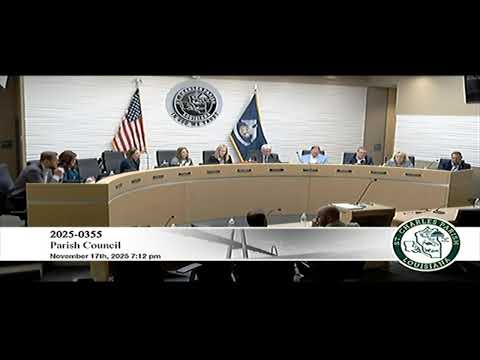
Thomas Scott, director of the tri-parish workforce office, told the Saint Charles Parish Council on Nov. 17 that the office “had another phenomenal year” despite federal budget cuts and ongoing demand for training and placement services.
Scott said the parish’s unemployment rate stood at about 3.7%, compared with a state average of 4.3%, and noted neighboring parishes’ rates (about 5.1% in St. John and 5% in St. James). He described a suite of no-cost services offered at local offices — job search assistance, resume preparation, soft-skills workshops, short-term technical training partnerships with RPCC and Delgado, and paid work-experience placements for 16–18-year-olds.
“Anyone can enter these centers and they can receive immediate assistance,” Scott said, describing an open-door policy and hours of operation. He detailed a rapid-response program that coordinates with the Louisiana Workforce Commission when employers lay off more than 50 people: staff open on-site orientations, assess transferable skills and run recruiting events using a bus outfitted as a computer lab.
Councilwoman Daniels asked how the rapid-response system works when a business leaves the parish and whether the program serves displaced middle managers as well as younger jobseekers. Scott replied that rapid response is a statewide partnership and that individual services, including one-on-one help, are available to workers at any career stage. He also said the local workforce office employs seven parish‑funded staff across its offices, supplemented by state Wagner‑Peyser staff.
Scott emphasized performance measures that determine future funding and reported the office met or exceeded the state-required targets, which he called a “report card” that affects year‑ahead allocations. He closed by inviting questions and thanking council members for their support.