Hardin County workshop urges officials, residents to map flood-prone sites to qualify for state funds
Loading...
Summary
At a Nov. 18 special meeting, Melinda Smith of Trader and Associates told Hardin County officials and residents to place flood-prone locations on an interactive Natchez regional map so projects can be ranked for the 2028 regional plan and eligibility for Flood Infrastructure Fund and other state programs.
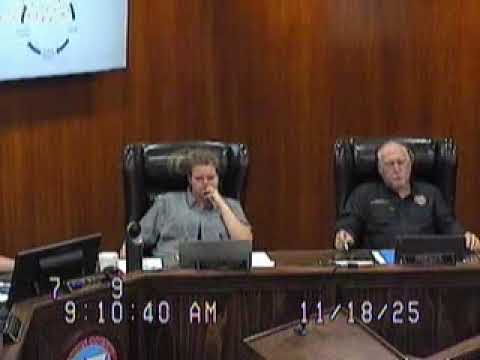
Hardin County officials met in a special Commissioners Court workshop on Nov. 18, 2025, to review development of the 2028 Natchez regional flood plan and how local projects can qualify for state flood infrastructure dollars. Melinda Smith, project manager and vice president at Trader and Associates, led the presentation and showed an interactive map the public and local officials can use to mark flood-prone sites.
Smith told the court that regional flood plans feed into a statewide plan and that projects must appear in the regional/state plans to be eligible for Flood Infrastructure Fund (FIF) awards. “You don't have to have an engineering degree … just drop a pen,” Smith said, describing the map tool and urging attendees to place “dots” that mark problem locations; technical staff will follow up to refine and, where appropriate, combine entries into larger regional projects.
Why it matters: Smith said two rounds of FIF and related programs have made more than $1.3 billion available statewide for studies, shovel-ready flood mitigation projects, and mitigation strategies such as gauges and safe rooms. She also said planning groups have about $2 million each for local studies, and that getting projects into the 2028 regional plan is a prerequisite for many state funding sources.
Presenters and participants walked through how the application process works: an initial intent and mapping step followed by full applications and engineering evaluations. Smith said the Texas Water Development Board will serve as the final approver on projects tied to the FIF process and that engineering documentation — hydrologic and hydraulic (H&H) studies certified by a qualified engineer — is required before a construction project will be accepted into program rolls to ensure no adverse downstream impacts.
Several commissioners and local officials described past barriers to participation, including staff turnover, misconceptions about program cycles, and local match requirements that had previously made larger projects unaffordable. One speaker said a county application once received only a small percentage of the requested amount and had to be declined because the local match was not feasible.
On prioritization, Smith said FIF scoring does not directly use low-to-moderate-income status alone but does use social-vulnerability metrics (a formula that includes income, age and household composition) along with benefit–cost analyses and critical-facility considerations. She said the recent funding cycles have increased emphasis on small rural communities and urged officials to be proactive in submitting project locations.
Local concerns raised during the workshop included the limits of mitigation for extreme storms — a participant said, “We’re not gonna prevent flooding in Lumberton, Texas” — and potential downstream effects when clearing land for major road or transmission-line projects. Ella McCann, a long-serving member of the Natchez River planning group, urged officials to protect natural resources and consider land-acquisition and conservation easements to keep vulnerable parcels out of the flood plain.
Next steps: Smith asked meeting participants to scan a QR code or use the map during the session, place points for known flood-prone sites, and expect a follow-up call from the technical team to collect more detailed project data. She said the list of proposed projects and studies is due in February or March and that money connected to the plan will be available in 2028.
Votes at a glance: Commissioner Kirkendall moved to adjourn the special meeting; the motion was seconded (the record identifies Cooper/Cook interchangeably) and the presiding officer called the meeting adjourned after an 'Aye' vote. Individual roll-call votes were not recorded in the transcript.
The workshop closed after participants practiced placing points on the map and discussed next steps for compiling project details and engineering evaluations. The technical team will follow up with commissioners and local contacts about project classification, potential funding matches and the engineering documentation needed to advance projects into funding rounds.