
Lake City approves first readings to send Price Creek land-use change to state review despite resident opposition
Get AI-powered insights, summaries, and transcripts
Subscribe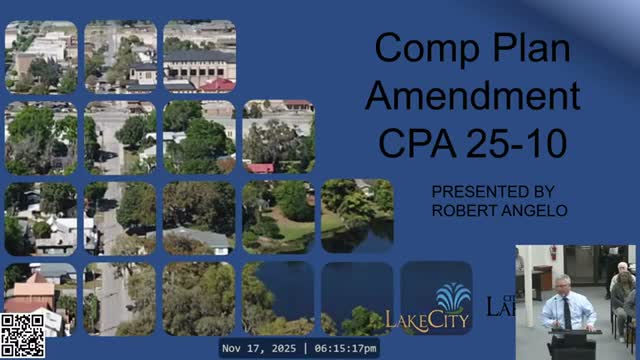
Summary
On Nov. 17 the Lake City Council approved first readings of a comprehensive-plan amendment and companion rezoning that would change more than 100 acres near Price Creek from county residential to city industrial; the measures advance to state review after strong public testimony from nearby residents about traffic, wetlands and property values.
The City of Lake City voted Nov. 17 to transmit to state review a large comprehensive-plan amendment and its companion rezoning request from Price Creek LLC after heated public testimony from nearby residents.
The two related measures — proposed ordinance 2025-2338 (the comprehensive-plan amendment, CPA 25-10) and ordinance 2025-2339 (the rezoning, Z25-12) — would change the property's future land use from county residential (very low density) to city industrial and rezone the parcel accordingly. Both items passed first reading on 3–2 votes and will return after state review and subsequent local hearing(s). Councilmember James Carter moved approval; the mayor and two councilmembers voted in favor; Councilmembers Jernigan and Harris voted no.
Why it matters: The parcel (parcel no. 07481-003) is more than 100 acres and includes a wetland that drains toward Alligator Lake and local groundwater, according to city planning staff. Nearby residents and landowners argued the designation would increase truck traffic on County Road 245A, introduce nighttime lighting and noise that could harm agricultural uses, and risk water contamination. Several speakers said the property was annexed in 2021 and alleged the rezoning attempts previously failed at the county level.
Nearby farmer Jonathan Akins told the council he has raised cattle on his property for decades and said the project would “adversely impact” groundwater and quality of life. Sam Bassett, speaking for a group of neighbors, urged the council to protect homes and farms “instead of helping investors,” citing a prior county denial and saying the parcel should remain residential or agricultural.
The city’s staff presentation and supporting reports concluded the amendment is internally consistent with the Lake City comprehensive plan and that the utilities and public facilities can meet projected demands at a planning level of review. Planning staff and the applicant’s attorneys emphasized that site-plan review, environmental resource permitting (ERP) from the water management district, and any special-exception hearings would follow before any particular industrial use could be built.
Utilities director Steve Brown told the council the property currently is served by a small (4-inch) water line along the road and that industrial-scale service would likely require much larger mains and potentially expensive line extensions; he said developers typically bear the cost of extending utilities.
Applicant attorney Patrick Kritchowski said the application, staff report and the record provide the “competent substantial evidence” required in quasi-judicial proceedings and that the applicant will comply with buffers and permitting obligations. He told the council that approving transmission to state review does not authorize any particular development and that site-specific impacts will be examined in later permit reviews.
Council members were divided. Carter argued sending the amendment to state review is appropriate and that the state process — which typically takes 30–90 days for review on large-scale amendments — will surface technical issues such as drainage and concurrency. Vice Mayor Shabella Young and Mayor Walker joined Carter in approving the measures on first reading. Councilmember Harris said she could not in good conscience support changing long-standing residential and agricultural land to industrial without knowledge of intended uses and more assurances about neighborhood protection.
Next steps: The comprehensive-plan amendment must be reviewed by the state; the rezoning will be held locally and would not be effective for development until both local and any required state approvals, site-plan reviews, ERP permits and, if applicable, special-exception processes are completed. The council’s first-reading approvals mean both items proceed to the next procedural stage, not that development is authorized.
Provenance: The council’s staff presentations and the applicant’s remarks, public testimony, and the first-reading vote appear throughout the meeting record; the substantive record begins with the staff presentation of CPA 25-10 and runs through the council’s first-reading roll calls.