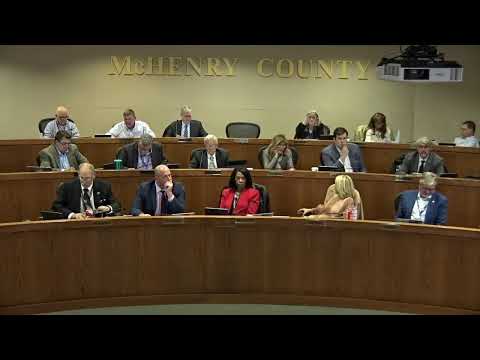
McHenry County board approves budget using CPI plus new growth after marathon levy debate
Loading...
Summary
After more than two hours of procedural votes and repeated motions to reconsider, the McHenry County Board approved a 2026 budget levy based on CPI plus new growth rather than the higher “look back” proposal; board members split sharply over fiscal reserves, the impact on taxpayers and the county’s long-term stability.
The McHenry County Board approved a 2026 budget and property-tax levy based on the consumer-price index (CPI) plus new growth after an extended, often contentious series of motions and roll-call votes.
Supporters of the CPI-and-new-growth approach argued it balances fiscal responsibility with taxpayer protection. “The look back corrects the imbalance. It doesn't undo the referendum. It simply restores our fiscal responsibility,” said Mr. Collins, urging his colleagues to shore up the county’s finances and avoid structural shortfalls.
Opponents called the higher “look back” option a breach of the board’s earlier commitments to voters. “I just want to point out a vote for this is a lie of what we said last year,” said Mr. Hendricks during debate, framing his opposition around the board’s prior public promises and the referendum that removed the Mental Health Board from the levy.
The board’s discussion repeatedly returned to two core choices: adopt the look-back abatement that would have restored a larger portion of prior levy revenue to the property-tax base, or adopt only CPI plus new-growth increases and use other reserves or targeted cuts to close projected shortfalls. Members cited a range of fiscal figures during debate, including an estimated shortfall of roughly $4.5 million in FY2027 if no action were taken and references to prior levy levels described at public comment time as moving from about $64,990,000 to $73,800,000 in one proposal.
County staff and elected officials pressed for clarity on the timing and the board’s statutory options. Treasurer and administration staff outlined that while the general fund remains strong, several special-revenue funds (notably FICA and IMRF) are being propped by the general fund and would be pressured without additional revenue or deeper cuts.
After repeated procedural motions to reconsider prior votes and an amendment process that opened the underlying question multiple times, the board ultimately passed the measure adopting CPI plus new growth (the motion to apply CPI/new growth was moved and seconded and the clerk recorded that the motion passed). The successful motion was presented to eliminate the previously proposed abatement/“look back” items (18b3 and 18b4) and instead move forward with items tied to CPI and reported new growth.
Board members on both sides emphasized future budget discipline: several said in-year reductions, scrutiny of vacant positions and program-level cuts would be necessary even after the vote. One member noted the administration had already identified more than $6 million in cuts during budget review.
What happens next: the board carried the CPI-and-new-growth levy as its budget action for the 2026 fiscal year; members said they expect continued discussion about midyear cuts and reserve policies to prevent future shortfalls.