
Council committee approves substitute to limit on-street parking for large vehicles, clarifies food-truck and emergency-access rules
Get AI-powered insights, summaries, and transcripts
Sign Up Free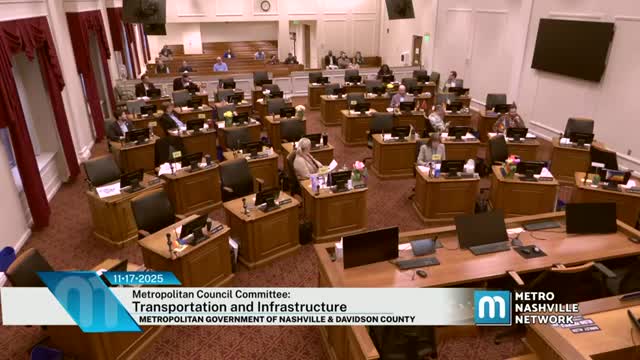
Summary
The Transportation & Infrastructure Committee approved a substituted version of BL2025-956 to restrict Class 4 and larger vehicles from parking on roadways while preserving a 12-foot emergency travel lane and allowing activity-based loading with enforcement discretion and a permit pathway.
The Metropolitan Council Transportation & Infrastructure Committee on Nov. 19 adopted a substituted ordinance (BL2025-956) that prohibits Class 4 vehicles from parking on roadways while preserving a 12-foot clear travel lane for emergency vehicles and allowing on-street activity for vehicles that are actively loading or unloading.
The committee voted in favor of the second substitute and then the bill as substituted; the chair recorded unanimous committee approval. The substitute was described by its sponsor as the version recommended by the Traffic & Parking Commission and intended to balance traffic-safety needs with downtown commercial activity such as food trucks.
During the discussion, Council Member Parker said the substitute reflects the Traffic & Parking Commission's recent work and that existing code already contains lane-width safety requirements. Council Member Allen and others asked whether the measure would allow a food truck providing service to park on the right-of-way. The sponsor and counsel said food trucks operating under the existing permit process would be permitted to provide service while the ordinance protects minimum clearance for emergency apparatus.
Chris Mitchell, council liaison for NDOT, said the 12-foot travel-lane standard is uniform: "It's 12 foot," and that the bill's clearance requirement mirrors ordinary lane-width standards. Mitchell and Brad Fries of the Nashville Department of Transportation explained enforcement would be handled by parking enforcement and that loading or unloading would be assessed by observable activity such as moving equipment out of a vehicle or similar work.
Members raised concerns about unintended consequences for residents and small-business owners who rely on on-street parking, including landscapers, delivery drivers and residents who rent moving vans. NDOT said the legislation includes a permit process and that enforcement officers would exercise discretion for livelihood-related uses and for residents without off-street parking.
David Pomeroy, president of the Nashville Musicians Association, had urged the committee during public comment to consider separate paid-parking actions affecting Music Row, saying the music community is "extremely disturbed" by a decision to convert 209 free spaces to paid parking and that there had been "no community engagement." Committee members clarified in discussion that BL2025-956 does not change paid-metered parking policy and that paid-parking questions are addressed in other processes.
The chair took the second substitute to a voice/show-of-hands vote and, after counting, corrected the tally to reflect full committee support. The ordinance will move forward as substituted.
What happens next: With committee approval, the bill as substituted advances to the full Metro Council calendar for further consideration under the council's legislative process.