Wastewater study committee outlines Route 9 sewer plan, asks Select Board for site help and design funding
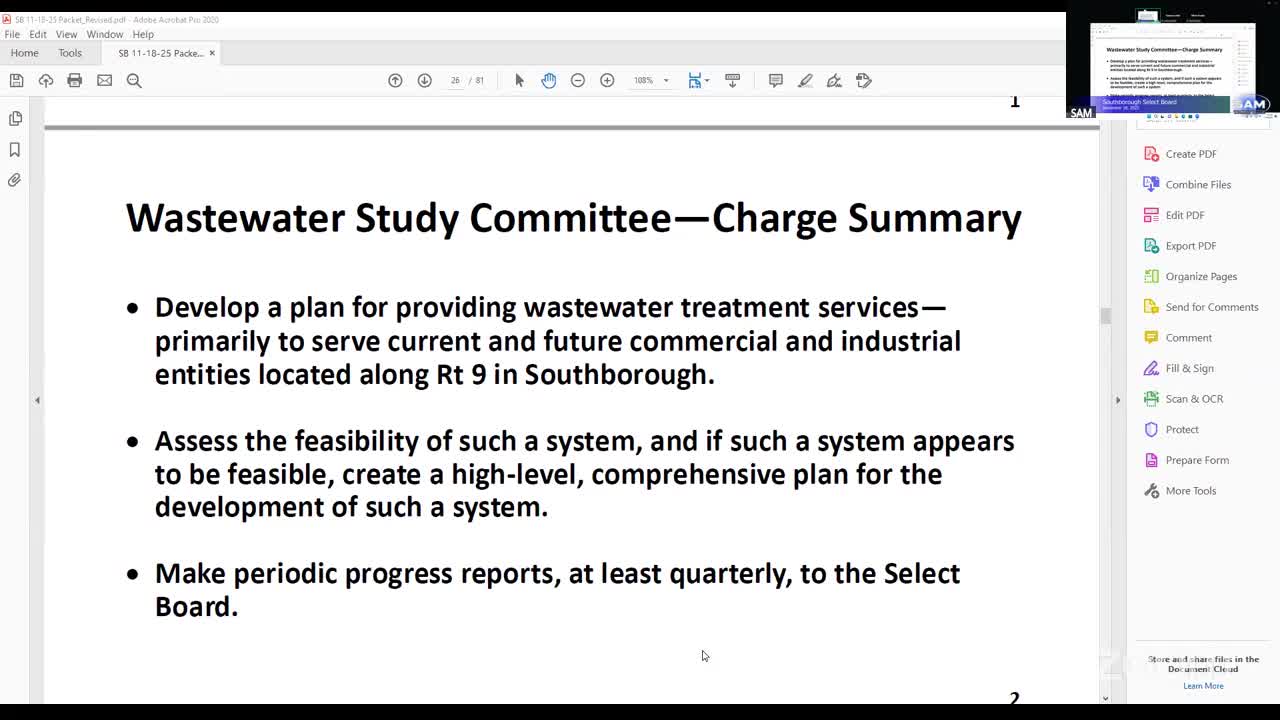
Summary
The Wastewater Study Committee told the Select Board it is technically feasible to build a Route 9 wastewater system and estimates it needs roughly 300,000 gallons per day (ideally up to 500,000) of capacity; the committee asked for Select Board help with site acquisition, outreach to potential system users and neighbors, and a design‑funding appropriation (a 'few $100,000') for site evaluation.
The Wastewater Study Committee presented a plan to the Select Board on Nov. 18 arguing that sewer service is the key enabler for commercial development along Route 9 and a long‑term means to relieve residential property‑tax pressure.
Sam Stivers, chair of the committee, said the group has identified potential plant and ground‑discharge sites and believes a system sized for Route 9 would need about 300,000 gallons per day of capacity and could benefit from expansion toward 500,000 gpd. He said a treatment plant footprint might require roughly five acres and that the ground‑discharge area could need 10–15 acres depending on soil conditions.
The committee reported the work so far shows technical feasibility but flagged financing for construction and initial operations as the primary obstacle. Stivers pointed to nearby examples — Littleton’s project and Madison Place — to show models of developer participation and financing blends that can reduce the initial burden on a town.
Committee members asked the Select Board to help in several ways: assist with site acquisition and access agreements for the plant and discharge areas, help identify and recruit other system users to increase volume, and back funding for early site evaluation work. The committee estimated that the initial design/site evaluation step would cost "a few $100,000" and said they plan to seek support at a 2026 town meeting.
The presentation noted state and federal funding programs and low‑interest loans as potential sources, but emphasized that many historic grant sources are no longer available and that the capital cost of a complete Route 9 system — plant, discharge fields and collection mains — could range widely (committee examples put total construction in the tens of millions). The committee described options to phase construction to reduce early costs and described district improvement financing and betterments as longer‑term payback mechanisms.
The Select Board and members of the public asked about site specificity, reuse of nearby facilities, potential impacts to private wells from groundwater discharge, and the timeline for coming back with a specific request. The committee said it has identified several candidate parcels and expects to return with narrower site recommendations and a refined design‑funding ask by the spring schedule for town meeting.
Next steps: the committee will continue site analyses, pursue potential grant and loan opportunities, continue outreach to neighboring communities and private developers, and seek Select Board assistance when they present a town‑meeting funding request for design and site evaluation.