
Nantucket advisory group hears push for transfer fee to fund year-round housing
Get AI-powered insights, summaries, and transcripts
Subscribe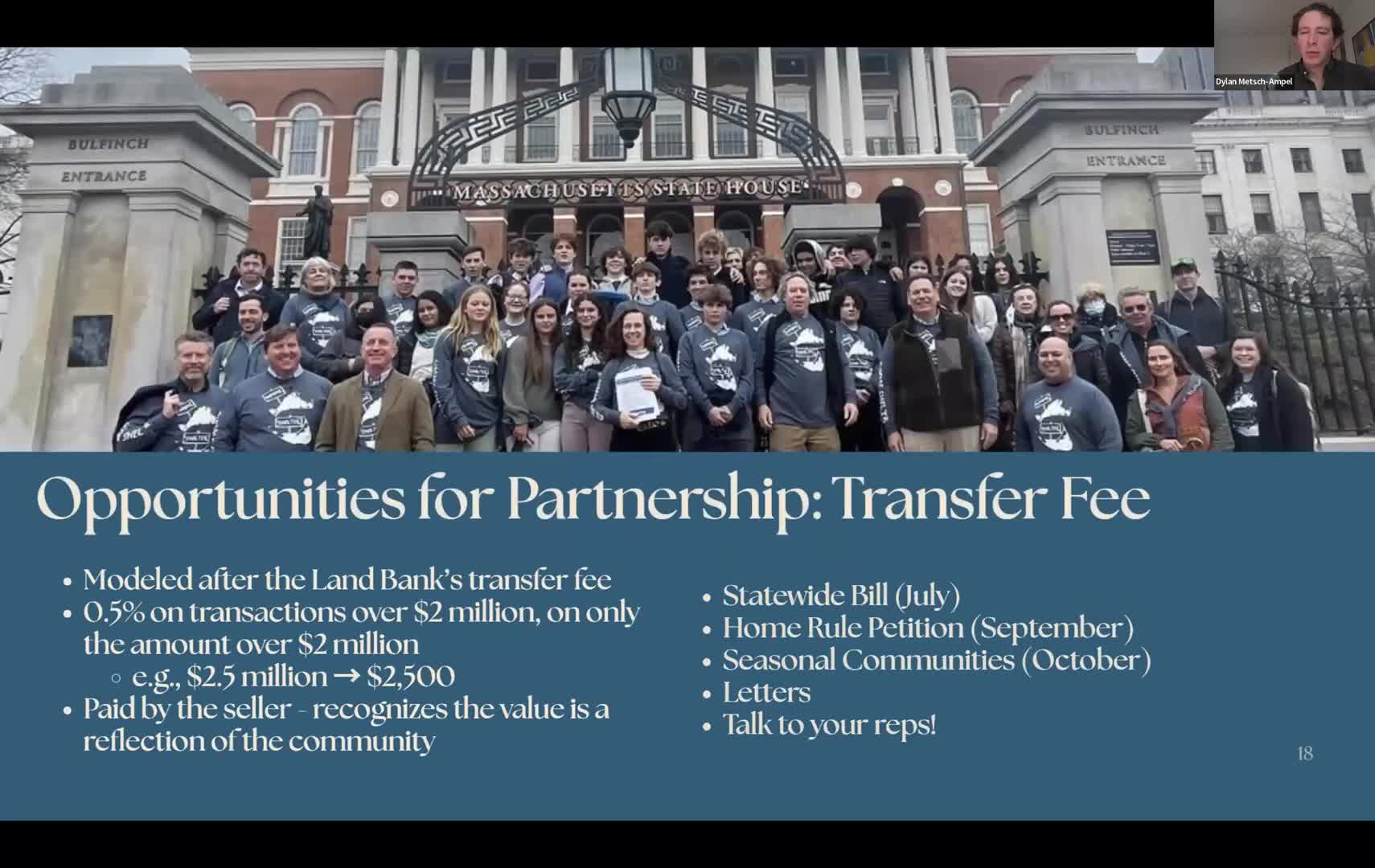
Summary
Town housing officials urged the nonvoting taxpayers advisory committee to back a real-estate transfer fee (a half-percent on amounts above $2 million proposed) and to send letters and calls to state legislators to secure a funding source for local affordable and year-round housing.
Housing officials urged the Advisory Committee of Nonvoting Taxpayers of Nantucket on Saturday to step into advocacy for a real-estate transfer fee they say could generate steady local funding for affordable and year-round housing.
Dylan Mechampl, deputy housing director for the Town of Nantucket, described the proposal as modeled on the island's existing land bank fee and said the draft local plan would place a 0.5% fee on sale proceeds above $2 million, with revenues earmarked for the Affordable Housing Trust. "If you sold a home for $2.5 million, you would pay a $2,500 fee that would be bookmarked for the affordable housing trust and used for affordable housing," Mechampl said during the presentation.
Sally (presenter, Affordable Housing Trust partner) and others described three legislative vehicles under consideration: a Home Rule petition tailored to Nantucket, a statewide enabling bill that would allow municipalities to opt in, and a transfer-fee option tied to the state's new seasonal communities designation. The presenters said opposition from the Massachusetts Association of Realtors (MAR) remains the largest hurdle but that local real-estate brokers on the island have sent supportive letters.
Committee members pressed presenters on design details: why 0.5% was chosen, who formally pays the fee and whether the rate could be raised later. Mechampl said the 0.5% figure reflects negotiation history and the need to craft a bill that can advance through the Legislature, adding that legislation can later adjust the rate or threshold. "It is dynamic," he said, noting a preliminary estimate that a half-percent fee could have yielded roughly $5 million for the town last year, before exemptions.
Advocacy ask: presenters asked the advisory committee and nonresident taxpayers to sign letters of support and to contact their state representatives and senators in Massachusetts. They noted timing constraints: written submissions for some legislative tracks were described as due in early December and asked whether the committee would consider reviewing and approving a draft letter for the joint committee on housing.
Meeting reaction and next steps: some committee members urged more time to review materials and to discuss impacts on taxpayers and the land bank; others urged immediate individual letters by advocates who are already engaged. Presenters committed to circulate draft language and supporting materials for the advisory committee to consider at its next meeting.
The committee did not take a formal vote of endorsement during the session.