
Pilot cliff stabilizers showing early gains; reef balls and dune projects advance in schematic phase
Get AI-powered insights, summaries, and transcripts
Subscribe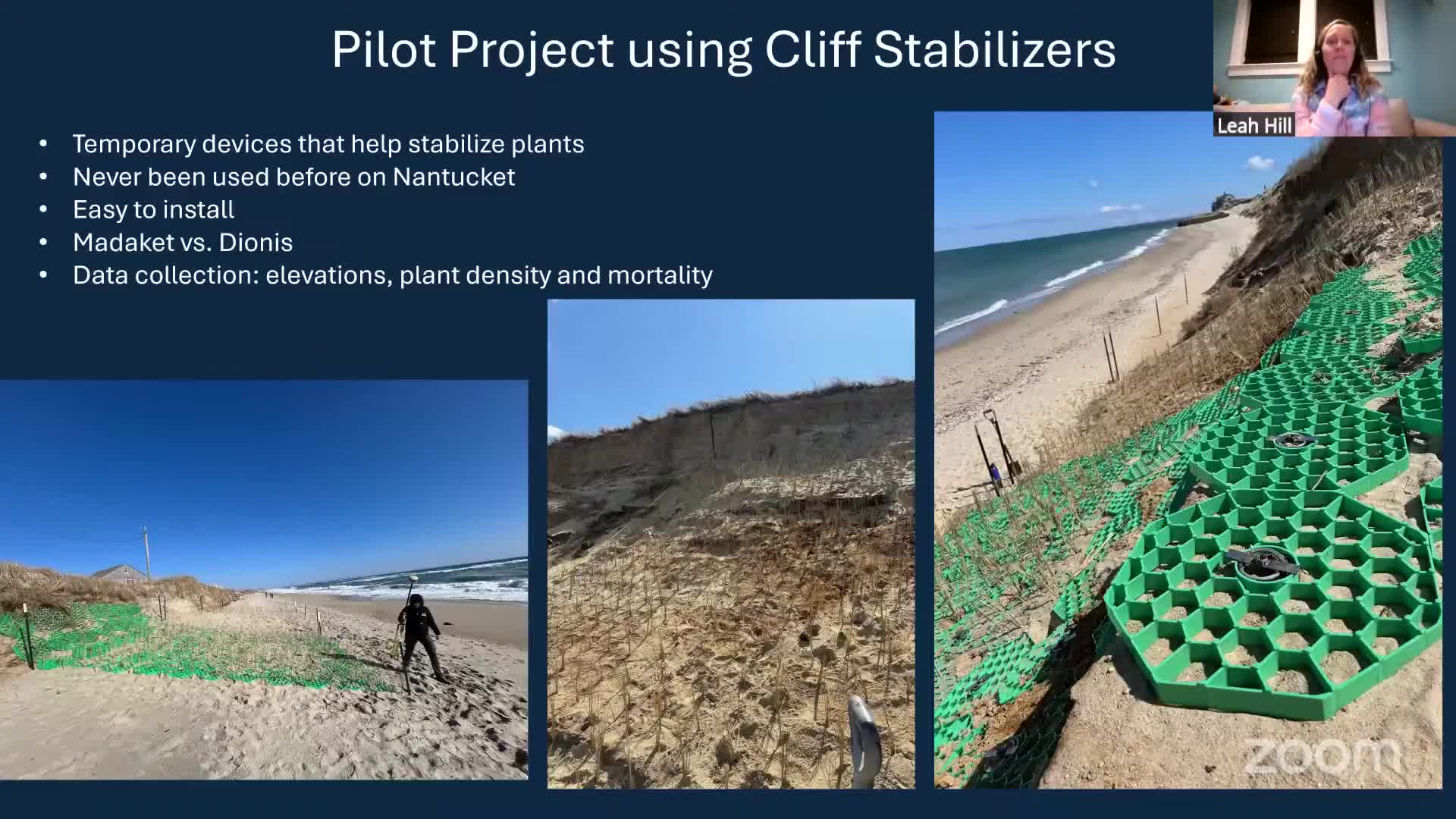
Summary
The town reported early success from March cliff‑stabilizer pilot installations at Madaket and Dionys Beach (about 1 foot elevation gain in one plot, and dune‑grass plots accreting ~5 in. vs a 2 in. control). Town staff also described Francis Street dune/boardwalk designs and Sacagawea Pond reef‑ball modeling, which showed a ~90% reduction in wave energy in modeled scenarios.
Leah, the town’s coastal resilience coordinator, told the Nov. 17 NPDC meeting that two pilot 'cliff stabilizer' systems installed in March are producing encouraging short‑term results. At the Madaket installation, Leah said the stabilized area increased in elevation by about a foot a few weeks after installation; a dune‑grass treatment plot accreted roughly five inches while an untreated control accumulated about two inches.
"They're temporary devices," Leah said of the honeycomb‑style stabilizers; the devices are screwed into the coastal bank, planted with dune grass and left until vegetation is established, at which point the devices can be removed and reused. She said vendor guidance is to keep the devices in for at least one full growing season and that the pilot would be wrapped up once grasses are reproducing.
On other shoreline projects, Leah described the Francis Street Beach improvement (dune creation, ADA boardwalk, rain garden and parking upgrades), currently in schematic design with a target of 30% design by December and a benefit‑cost and operations plan under way. She also described plans at Sacagawea Pond to replace temporary Jersey barriers with a sheet‑pile wall, restore a coastal bank and place 'reef balls' — concrete, eco‑friendly structures that act as living breakwaters. Leah reported modeling results showing reef balls could reduce wave energy by roughly 90% in the pond setting and that the technique supports oyster habitat and water filtration.
Commissioners and attendees asked about permitting and state licensing (Chapter 91) and whether reef balls are appropriate for high‑energy south‑shore exposures; Leah said reef balls are better suited to ponds and harbor settings and that regulatory changes or specific permits would be required for certain placements. She also said staff has been meeting every three weeks with partners, including Mass Audubon, on Sacagawea work.
Leah noted the town received a Coastal Zone Management grant “a little over 300,000” for a Surfside wastewater dune restoration project and said the sediment‑budget and retreat/relocation efforts are also moving forward.
Next steps: maintain pilot devices through the growing season, complete monitoring and reporting, advance Francis Street 30% schematic design, continue reef‑ball permitting conversations and pursue required state approvals before in‑water or shoreline construction.