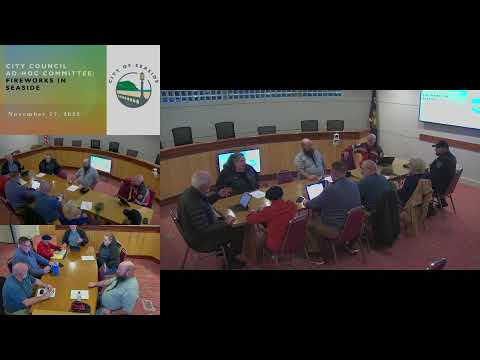
Seaside advisory committee backs education-and-enforcement campaign, debates $5,000 fine
Loading...
Summary
An advisory committee in Seaside recommended that City Council pursue an education-and-enforcement campaign against illegal fireworks on the beach and explore a tiered fine schedule (discussed between $2,500 and $5,000), while asking staff to cost staffing and signage before council action.
SEASIDE, Ore. — A Seaside advisory committee on Tuesday agreed to recommend that City Council pursue a combined education-and-enforcement campaign aimed at reducing illegal fireworks on the city’s beaches and to consider a tiered fine schedule, after a lengthy debate over deterrence, fairness and cost.
Committee members emphasized a two-pronged approach: prominent temporary signage and a public-education effort, plus consistent enforcement. “Getting caught with illegal fireworks, $5,000. Spending a fine-free holiday at Seaside, priceless,” a tourism official said in a staff email quoted during the meeting as the kind of “funny but serious” messaging the city could use. Members discussed in-house, low-cost and full-service marketing options ranging from no-cost social posts to full campaigns that could reach $10,000–$50,000.
Why it matters: The committee framed the strategy as a way to protect public safety, reduce litter and preserve the family-friendly character of the beach by discouraging visitors from bringing large mortar shells and other illegal devices. Members said visible warnings and people stationed at beach entrances would reinforce enforcement and help establish that visitors had notice before any citation.
What was proposed and debated: Committee members debated whether a $5,000 fine is the right deterrent. Some speakers argued the higher amount is necessary to change behavior; others warned $5,000 could be disproportionate, politically unpopular and subject to judicial reduction. The committee discussed a tiered approach — for example, a lower first-offense amount (discussed at $2,500 or less) that could escalate toward a $5,000 maximum — and asked staff to draft ordinance language that would give officers guidance and preserve judge discretion.
Operational details and costs: Members pressed for an operational cost estimate before sending recommendations to council. Committee discussion identified specific items for the council packet: the number of staffed entrances (24 was cited as a planning figure), an estimated $30-per-hour cost for staffing entrances, signage costs (roughly $200 per mesh banner was referenced), and the potential use of Transient Lodging Tax (TLT) funds to underwrite education and staffing. Staff said an ordinance would typically require multiple council readings plus a 30-day period and suggested early next year or March as a target for council consideration.
Next steps: The committee agreed that Spencer (staff) will draft the campaign scope, costing and a recommended tiered fine schedule to present to council. The committee also recommended asking the council to consider hiring a creative firm to develop messaging and brand assets, but left final budget and procurement decisions to the council.
Voices from the meeting: Sandy Mercer (committee member) and several others emphasized education tied to enforcement; Guy Knight, identified in the meeting as an officer, described practical limits on searches — “If you can’t see it, it’s a search” — noting officers need to see contraband to seize it lawfully. Multiple members said they preferred a tiered fine that allows for officer discretion and possible court mitigation for low-level, inadvertent violations.
Limitations on enforcement: The committee noted constraints under state parks rules and state law discussed during the meeting, including that volunteers cannot conduct warrantless bag searches and that state statute sets certain fines and court discretion. Committee members instructed staff to clarify these legal limits in the packet to council.
The committee did not take a formal vote on an ordinance but recorded consensus recommendations to develop a draft ordinance, estimate operational costs, and prepare a communications plan for council consideration. Spencer will return with a written proposal for the committee and for the City Council’s review.