
Summit elementary STEAM marks five years as students, teacher highlight hands‑on learning
Get AI-powered insights, summaries, and transcripts
Sign Up Free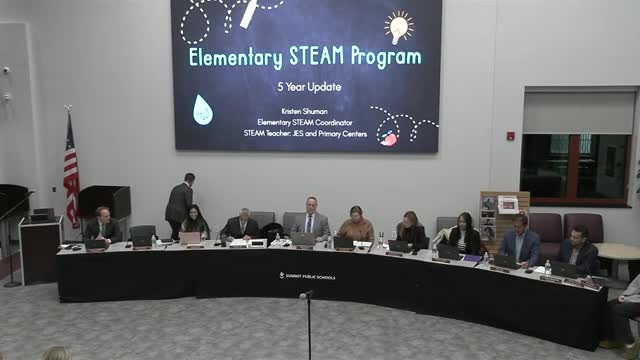
Summary
Kristen Schumann and Jefferson Elementary students presented a five‑year update on the district K–5 STEAM program, describing dedicated labs, cross‑grade alignment, robotics and coding units, and teacher reports of higher engagement and improved middle‑school science readiness.
Kristen Schumann, the Summit Public School District STEAM coordinator at Jefferson Elementary School, presented a five‑year update on the district’s K–5 STEAM program, describing dedicated STEAM labs in every elementary school and a curriculum built around robotics, coding, science units and year‑end design challenges.
Schumann told the board the program uses an engineering design process — ask, imagine, plan, create, test and improve — to teach students hands‑on problem solving and 21st‑century skills such as creativity, collaboration and critical thinking. She cited classroom examples including a second‑grade plant‑growth experiment with controlled variables, a fourth‑grade sound‑box decibel challenge, and a fifth‑grade ramp and race‑car design project that involved collaboration with high‑school tech‑ed students.
"We do real‑world problem solving," Schumann said, describing how each grade builds on coding and robotics skills introduced earlier in the sequence. She said the program emphasizes the process over the final product, and that teachers have observed students demonstrating a growth mindset when iterative testing does not work initially.
Two Jefferson students who joined the presentation gave concrete examples of classroom impact. Fifth‑grader Harris said STEAM "is my favorite class" because it is collaborative and challenges students to persevere; he added that after five years of the program he "can't imagine school without STEAM." Third‑grader Iris described the plant experiment and said STEAM "makes learning fun." The students’ remarks were followed by a brief audience question about the plant experiment, to which a student replied the group that used tap water saw the best growth.
Schumann also connected STEAM instruction to district goals on authentic, project‑based learning and said middle‑school science teachers report students are arriving better prepared. The coordinator noted STEAM career week activities that brought community professionals into classrooms and highlighted the program’s role in exposing students to potential careers in science and technology.
The presentation concluded with the board thanking Schumann and the students. No formal board action was required on the presentation; the program update was presented for information and committee follow‑ups on curriculum and related initiatives were noted.