
Investigation: Skokiewater main failure caused by deteriorated 1950s junctions; village to assess transmission mains
Get AI-powered insights, summaries, and transcripts
Subscribe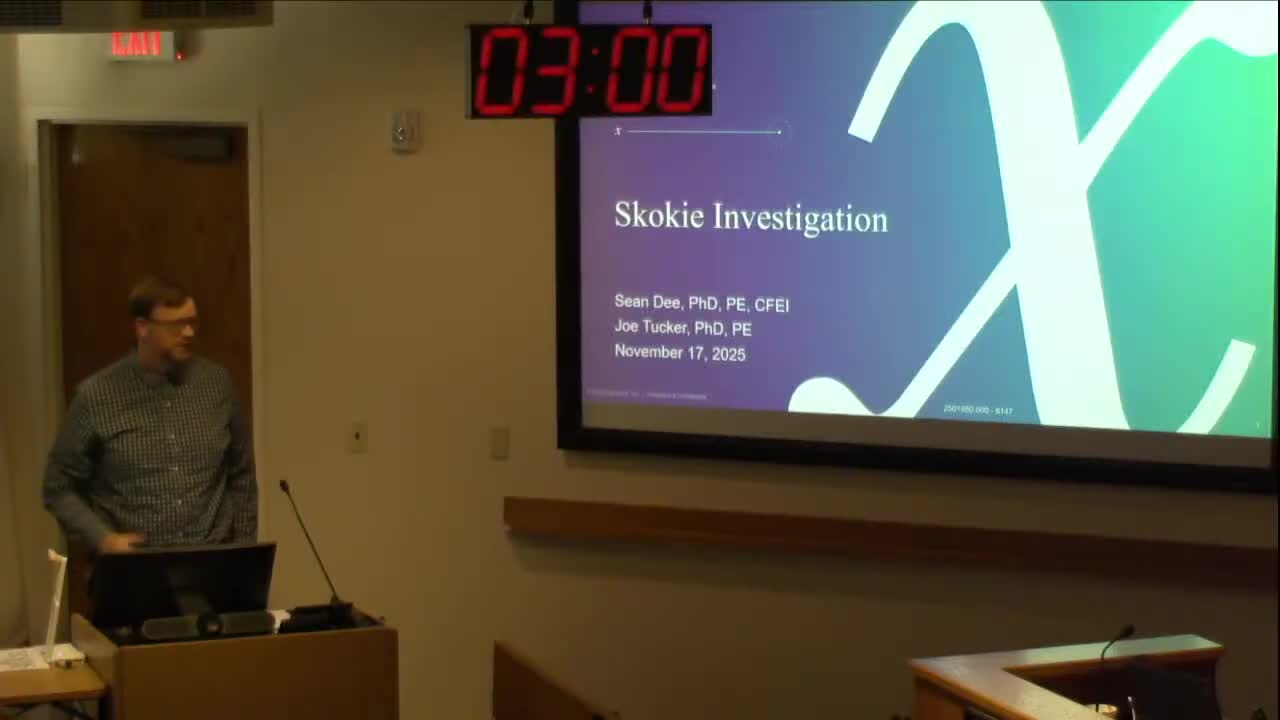
Summary
A forensic investigation found a missing end cap on a 36-inch Y assembly likely liberated by gradual deterioration and inadequate thrust blocking; Skokie removed two vulnerable assemblies, will issue an RFQ for assessment of 20-inch-and-larger transmission mains, and outlined emergency-response and communication improvements.
A forensic team hired by the village concluded that a Feb. 14 full-bore water release in Skokie was caused by the gradual deterioration and displacement of an end cap on a 36-inch Y assembly, rather than a single, catastrophic pressure event.
Dr. Sean Dee of Exponent told the Village Board on Nov. 17 that the excavated assembly near East Prairie Road and Emerson Street carried fabrication markings consistent with mid-1950s installation; X-ray fluorescence testing found lead consistent with an oakum-and-lead seal. "The most likely potential cause or primary cause of the liberation or separation of this end cap was the gradual deterioration of this Y assembly, driven primarily by inadequate thrust blocking in the buried installed condition on the assembly," Dee said.
The investigator compared three excavated assemblies: the subject junction (marked 1956) with a missing end cap; a Church Street/East Prairie assembly (marked 1954) with robust timbers serving as thrust blocking; and a Sculpture Park assembly (marked 1956) showing outward displacement of the end cap and corrosion deposits consistent with a gradual process. Dee said evidence does not show a pressure transient immediately preceding the failure and that the missing cap was likely displaced into the surrounding soils by flow.
Public Works Director Max Slinkard said the village has already removed and replaced two other vulnerable Y joints on the interconnection line with single-piece elbow connectors and more modern thrust restraint systems. "We will put out an RFQ within the next week or 10 days" to hire condition-assessment services for transmission mains 20 inches and larger, Slinkard said; the assessment will focus on wall thickness and other nondestructive technologies recommended by experts.
Slinkard and staff also outlined operational and communications lessons learned. The village plans adjustments to its emergency operations center (EOC) tiering, the deployment of on-scene community liaisons for affected neighborhoods, and a phone-system upgrade in 2026 to avoid overloaded lines during incidents. Slinkard said officials will review staging for water distribution, formalize memoranda of understanding for distribution sites, and pursue emergency interconnection agreements with nearby wholesale suppliers.
Trustees pressed staff on the likelihood of similar vulnerabilities elsewhere in the system, limits of nondestructive testing for junctions, and next steps for integrating findings into the villages capital improvement plan. Slinkard confirmed the focus for now is the transmission infrastructure (generally 20 inches and larger, about 50,000 lineal feet of pipe) and that the RFQ will seek solutions tailored to Skokies pipe sizes, pressures, and flow conditions.
The village emphasized coordination with the schools and other institutions when issuing community notices during incidents and said it intends to publish the Exponent report in the board packet (it is online with the meeting packet). More detailed repair and assessment work, including timelines and funding plans, will be brought to the board as consultants present recommendations.