
Pasco County hears mobility‑fee study showing $6.9 billion need, options to close $2.9 billion gap
Get AI-powered insights, summaries, and transcripts
Subscribe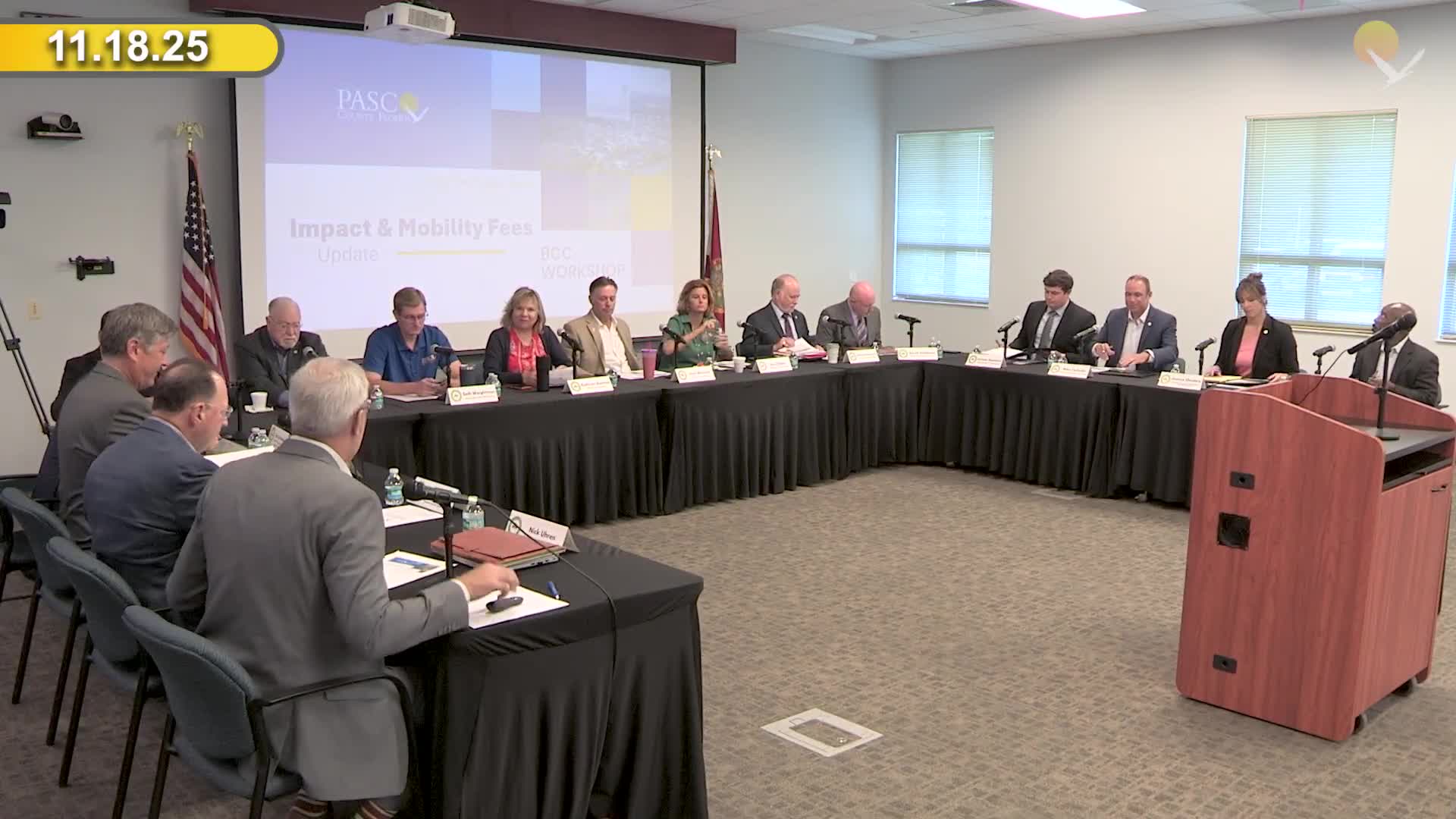
Summary
County staff told commissioners that Pasco faces about $6.9 billion in transportation needs over 25 years and an estimated $2.9 billion shortfall; staff presented options including removing multifamily subsidies, raising suburban single‑family fees toward ~$13,000–$14,000, protecting locally owned small businesses, and seeking grants and partnerships.
Pasco County on Nov. 18 heard a detailed mobility‑fee study that found roughly $6.9 billion in transportation capital needs over the next 25 years and an estimated funding shortfall of about $2.9 billion.
County Engineer Nick (presenting staff) told the board that, under current assumptions, the county’s five principal revenue streams — federal and state allocations, the Penny for Pasco sales tax, local option gas taxes, tax‑increment financing and mobility fees — would produce about $4.0 billion, leaving the county short of the study’s projected $6.9 billion need. "That total cost that we need to invest in our transportation system is $6,900,000,000," Nick said; "we have a shortfall of about $2,900,000,000." (presentation to the board).
Why it matters: the mobility fee pays for right‑of‑way acquisition, design and construction of roads and multimodal facilities (bike/pedestrian/transit). Staff emphasized that Pasco is unusually heavily unincorporated — a factor that concentrates the county’s responsibility for infrastructure — and that cost increases since the 2021 study and a larger population forecast have widened the gap.
What staff told the board: Nick reviewed the current fee structure for a typical suburban single‑family home (about $9,600 mobility fee; total impact fees just under $25,000 including schools, parks and other charges). He outlined three principal levers to address the shortfall: (1) change fee rates or incentives for particular land uses; (2) reduce the scale or service level of the planned roadway network; and (3) add external revenue (grants, appropriations, bonding/accelerated financing). Staff also identified legal and procedural constraints on fee changes under Florida law, including limits on how and when increases may be phased.
Board discussion and direction: commissioners debated trade‑offs between raising fees and protecting affordability and local small businesses. There was general support to: - Remove or substantially reduce the multifamily subsidy (staff said the update can move multifamily back toward a 0% subsidy and that doing so would not exceed the 50% statutory threshold), - Preserve or strengthen the locally owned small‑business reduced rate (currently implemented by the county), - Consider moving the suburban single‑family fee from the current ~$9,600 toward a parity figure near ~$13,000 (a roughly 25% increase), with several commissioners asking staff to model faster phasing (two‑year vs four‑year implementation) and to show impacts on affordability for long‑time residents and first‑time buyers, and - Pursue a mix of options rather than a single fix: run scenarios combining partial fee increases, targeted incentives for job‑creating development, regional grant requests, and more rapid project delivery (including bonding against future TIF revenue).
Legal and procedural limits: staff and the consultant reviewed relevant state limits on fee updates — fees may be updated on a four‑year cycle and increases over certain thresholds require specific findings and phased implementation. Staff advised that increases above 50% of the then‑current fee typically require a unanimous board finding and must be phased in.
Corridor and regional coordination: commissioners raised east‑west connectivity north of State Road 52 and discussed Ayers Road and County Line Road, noting portions of proposed extensions sit in Hernando County or require DOT feasibility work. Staff said they will provide formal feedback to FDOT and pursue coordination with Hernando on corridor and funding strategies.
Next steps: staff will run refined scenarios (detailed fee tables and revenue impacts), hold one‑on‑one briefings with commissioners, engage development‑industry stakeholders and the horizontal roundtable for feedback, and return with ordinance language and a recommended timeline. Staff presented a target schedule with public hearings/first reading in March–April and adoption thereafter and said the county will present an ordinance in December to maintain the 2025 fee schedule until the update is complete. Commissioners asked staff to accelerate stakeholder outreach where feasible.
Context and numbers (from the staff presentation): the study supports a maximum justified suburban single‑family mobility fee near $18,200 under the study’s assumptions, with a consumer‑inflation parity figure nearer $13,000; federal gas tax revenue and local gas taxes are historically flat in purchasing power; TIF and Penny for Pasco sales tax contribute materially but do not cover the full need; mobility fees at current rates generate roughly $1.0 billion of the projected revenue over 25 years.
What remains unresolved: board members differ on the acceptable balance between raising fees to fund projects and protecting housing affordability or preserving incentives for employers; staff will return with modeling showing how various combinations of fee changes, service‑level adjustments and external funding close the gap. The workshop did not include any final votes or ordinance adoptions; it was a policy direction and fact‑finding session, followed by staff assignments and a schedule for stakeholder engagement and ordinance drafting.
The county scheduled follow‑up outreach and analysis and intends to return to the board with detailed options and recommended fee tables before any ordinance vote.