
Spokane board reviews Kittelson contract for city bikeway design guide and Vision Zero update
Get AI-powered insights, summaries, and transcripts
Sign Up Free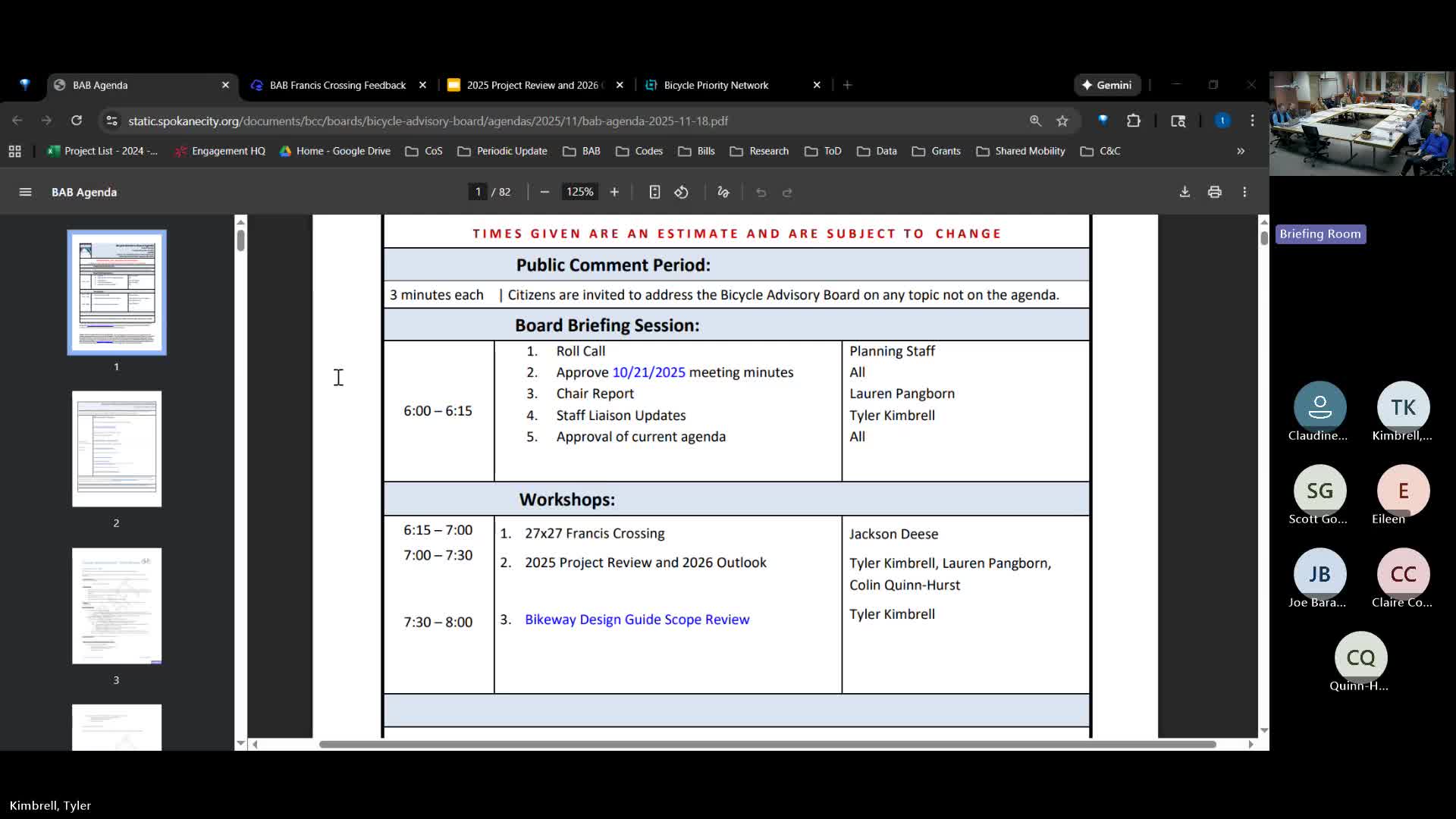
Summary
City staff told the Bicycle Advisory Board that a contract with Kittelson will produce a bikeway design guide, a Vision Zero-style comprehensive safety action plan and a quick-build guide; work includes facility standards, intersection treatments and community engagement through 2026 with expected reference in engineering projects by 2028.
Tyler, a city transportation staffer, told the Bicycle Advisory Board on Nov. 18 that the city has awarded an RFQ to the consultant Kittelson to produce three deliverables: a bikeway design guide to be integrated into the city’s street design standards, a Vision Zero-style comprehensive safety action plan, and a city quick-build guide to accelerate low-cost projects.
The design guide will add tables and exhibits with bikeway dimensions for different facility types, guidance for signing and striping, instructions for bus-stop interactions, temporary traffic control for construction, and intersection treatments such as protected intersection layouts and two-stage bicycle turn boxes. Tyler said the materials aim to give engineers, elected officials and the public clearer expectations about how projects will be built.
Tyler said the Vision Zero-style plan will analyze crash data to prioritize countermeasures and will support grant applications that require a comprehensive safety plan. He proposed a roughly two-year engagement with stakeholder and community outreach that could extend into 2026; he added that the documents are likely to begin appearing in project design references by 2028.
Board members asked about how the guides will be revised and whether there will be a formal variance process for constrained projects that cannot meet standards. Tyler said most design manuals include a variance path that identifies minimum acceptable alternatives when a standard is infeasible and that the contract includes a revision process incorporating public feedback. He also said Kittelson’s proposals and the RFQ materials are posted in the agenda packet and that staff will circulate materials by email.
Several members said the guides could help hold the city accountable to its bicycle-priority network by reducing the ad hoc nature of facility decisions on resurfacing projects. Tyler said the quick-build guide is intended to speed implementation of routes such as the 27-by-27 network and that the city plans to reference the quick-build guidance for projects delivered ahead of full reconstruction.
The board did not take a formal vote on the contract during the meeting. Tyler said staff expects to complete community engagement and draft products during the contract period and that the city’s street design standards would be updated through the normal adoption process.